

What is Agentic AI?
If you’ve spent any time following AI news over the past year or two, you’ve probably noticed the term “agentic AI” showing up everywhere, often without a clear explanation of what actually separates it from the chatbots most people are already used to. That gap matters, because the distinction isn’t just marketing language. It reflects a genuine shift in what these systems can do.
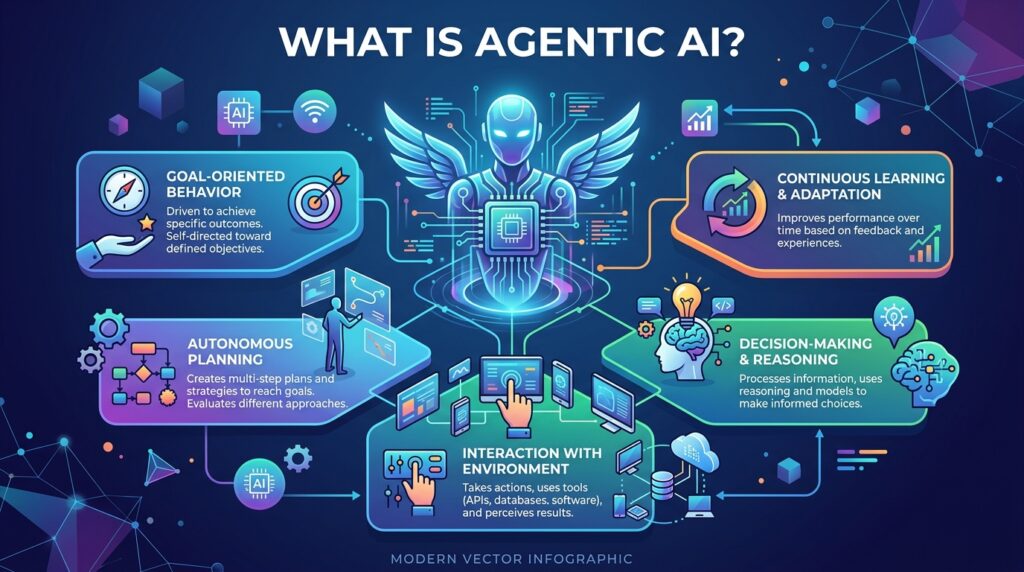
This technology is being built into everything from customer service platforms to coding assistants to research tools, and for freelancers, remote workers, and digital professionals, understanding it is quickly becoming as practical a skill as understanding spreadsheets or project management software once was. You don’t need a technical background to get a working grasp of it, but you do need a clear, accurate explanation rather than buzzword soup.
This guide breaks down what this technology actually is, how it differs from the AI tools you’re probably already using, and then walks through a practical, step-by-step approach for trying it out in your own work without overcommitting or overtrusting a system that’s still evolving quickly.
Agentic AI Definition, Examples, and Why It Matters ?
According to Stanford’s Institute for Human-Centered AI, agentic AI refers to AI systems designed to act as autonomous or semi-autonomous agents, capable of setting or interpreting goals, planning and sequencing actions, using tools like web browsers, code, or APIs, and adapting over time to complete tasks with minimal ongoing human input.
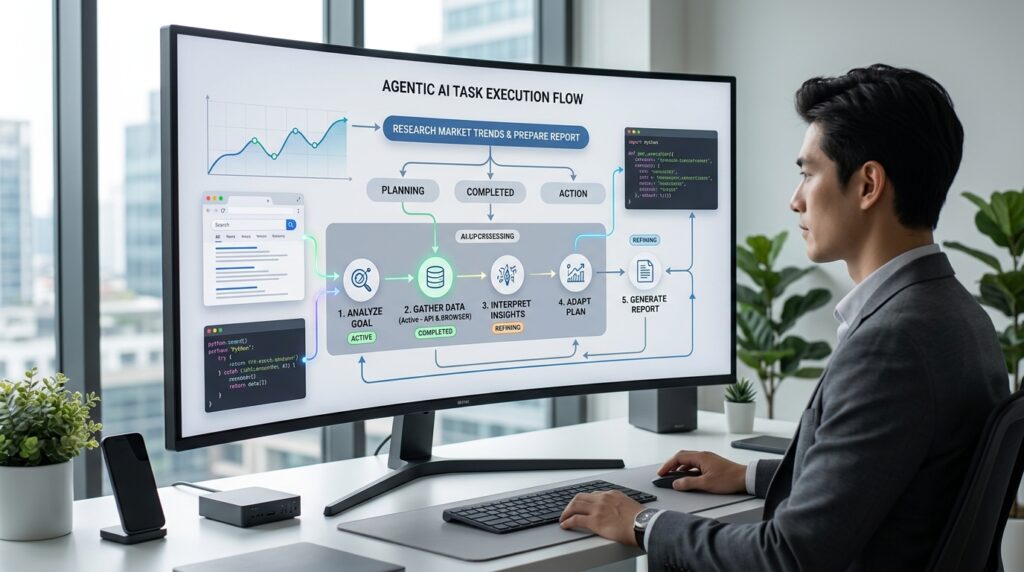
The simplest way to understand it is by comparison. A standard AI chatbot answers one question or completes one request at a time; you ask, it responds, and the interaction pauses until you ask again. This kind of system is built to keep going: given a broader goal, it can break that goal into smaller steps, decide what tools or information it needs, carry out those steps, check its own progress, and adjust its approach, often across multiple actions, with far less back-and-forth from a human.
A practical example makes this clearer. Imagine asking an AI tool to “research three competitor pricing pages and summarize the differences.” A traditional chatbot might do this only if you fed it the content directly. An agentic AI system, by contrast, could search for the pages itself, extract the relevant pricing details, compare them, and return a structured summary, handling each sub-step on its own within whatever boundaries it’s been given.

That said, this kind of system isn’t the same as full autonomy without oversight. Most well-designed systems still operate within defined constraints, permissions, and checkpoints, precisely because unsupervised, multi-step action carries real risk if something goes wrong partway through.
This distinction also explains why the technology is spreading so quickly across so many industries. Customer support platforms use it to resolve routine tickets end-to-end. Coding tools use it to plan, write, test, and revise code across multiple files. Research and analytics platforms use it to gather information from several sources and compile it into a single, structured output. In each case, the underlying pattern is the same: a broader goal gets broken into steps, and the system works through those steps with progressively less need for a human to intervene at every stage.
Step-by-Step Guide: How to Start Using Agentic AI in Your Work
If you’re a freelancer, remote worker, or digital professional curious about trying this technology without diving in blindly, here’s a practical, cautious approach.
Step 1: Identify a Task Worth Automating

What to do: Look for a task in your workflow that’s repetitive, multi-step, and reasonably low-risk if something goes slightly wrong, such as research summaries, initial drafts, or basic data organization.
Why it matters: These tools are most useful on tasks with clear structure and forgiving stakes. Starting with something high-stakes, like sending client invoices or publishing content unreviewed, is a common way early experiments go wrong.
Example: A freelance writer might start by having an agentic tool gather and summarize background research for an article, rather than trusting it to publish a finished piece directly to a client’s site.
Step 2: Choose the Right Type of Tool for the Task
What to do: Research whether the tool you’re considering is genuinely agentic (capable of multi-step planning and tool use) or simply a chatbot with an agentic-sounding name.

Why it matters: Not every tool marketed with “agent” or “agentic” in its name actually plans and executes multi-step tasks independently. Understanding the real capability before relying on it prevents wasted time and misplaced trust.
Step 3: Set Clear Goals and Guardrails Before You Start
What to do: Define exactly what the tool is allowed to do, what it should ask permission for, and what it should never do without your review.
Why it matters: Because this technology is designed to take initiative across multiple steps, unclear boundaries can lead to actions you didn’t intend, like sending an email prematurely or making a purchase-related decision without your approval.
Step 4: Start With a Low-Risk Pilot Task
What to do: Run your first attempt on something small and reversible, and review the entire output before it touches anything client-facing or public.
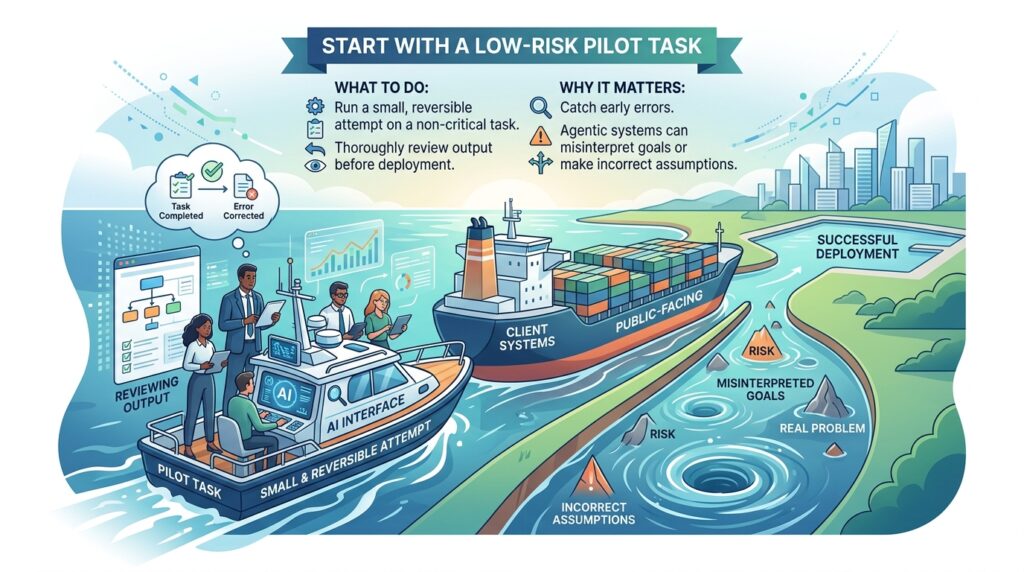
Why it matters: Agentic systems can occasionally misinterpret a goal or make an incorrect assumption partway through a multi-step task. A small pilot lets you catch this before it becomes a real problem.
Step 5: Monitor and Review Outputs Closely
What to do: Read through what the tool actually did, not just the final result, especially early on while you’re still calibrating how much to trust it.

Why it matters: Understanding the steps such a system took, not just its final answer, helps you spot patterns in where it performs well and where it needs closer supervision.
Step 6: Scale Up Gradually and Document What Works
What to do: Once you’re confident in a specific use case, expand it carefully, and keep notes on what tasks the tool consistently handles well versus where it still needs human review.
Why it matters: These tools vary widely in reliability depending on the task. A documented, gradual approach helps you build genuine efficiency rather than a false sense of security.
Step 7: Consider the Skills and Career Angle
What to do: If you’re a freelancer, remote worker, or job seeker, treat learning to work effectively alongside agentic AI as a developing professional skill, similar to how learning spreadsheet automation or basic scripting became valuable over the past decade.

Why it matters: Employers and clients are increasingly interested in people who can direct, review, and responsibly manage AI-assisted workflows. That said, this is a developing skill area rather than a guaranteed path to specific income or job outcomes, and results will vary depending on your industry, existing skills, and how quickly your particular field adopts these tools.
Example: A virtual assistant who learns to supervise an AI research and scheduling workflow, reviewing its outputs and correcting its mistakes, may find that skill genuinely valuable to clients over time, though it’s reasonable to treat this as one useful skill among several rather than a standalone career strategy.
Common Mistakes to Avoid
- Giving a system too much autonomy too soon. Start with narrow, supervised tasks before expanding scope.
- Assuming “agentic” always means fully autonomous. Capabilities vary widely between products; verify what a specific tool actually does.
- Skipping the review step. Even reliable AI agent tools can make mistakes mid-task; reviewing outputs is not optional, especially early on.
- Using it for high-stakes, irreversible actions before testing thoroughly. Financial transactions, client communications, and published content deserve extra caution.
- Ignoring data privacy and permissions. Understand what data a tool can access and share before connecting it to sensitive accounts or client information.
Useful Tips
- Read a tool’s documentation on what permissions and data access it requires before connecting it to anything sensitive.
- Keep a simple log of what tasks you’ve delegated to this technology and how well each one performed, so you can refine your approach over time.
- Start with tools that clearly show their intermediate steps, not just a final output, so you can audit the process.
- Treat early results with healthy skepticism, even when they look polished; multi-step AI processes can look confident while still containing errors.
- If you’re building professional skills around this area, focus on understanding how to direct and review it, not just how to prompt it.
Frequently Asked Questions
Is agentic AI the same as a chatbot? No. A standard chatbot typically responds to one request at a time, while this technology is designed to plan and carry out multiple steps toward a broader goal with less ongoing human input at each stage.
Is this technology safe to use for business tasks? It can be, with appropriate guardrails, permissions, and human review, especially for lower-stakes tasks. Higher-stakes or irreversible actions generally warrant closer oversight.
Do I need to know how to code to use this technology? Not necessarily. Many consumer and business-facing AI agent tools are designed for non-technical users, though understanding the basics of how they operate helps you use them more effectively and safely.
Will agentic AI replace freelance or remote jobs? It’s changing how certain tasks get done, but outcomes vary significantly by industry and role. Rather than guaranteeing job loss or job creation, most current evidence suggests it’s reshaping how work gets divided between people and tools.
How is this technology different from general automation tools? Traditional automation typically follows fixed, predefined steps. This technology can interpret a broader goal, decide its own steps, and adapt partway through a task based on what it encounters.
Final Thoughts

Agentic AI represents a genuine shift from AI tools that simply respond to ones that can plan, act, and adapt across multiple steps toward a goal. That capability makes it genuinely useful for freelancers, remote workers, and digital professionals looking to streamline parts of their workflow, but it also comes with real responsibility around oversight, permissions, and review.
If you’re considering trying this technology in your own work, the practical next step is simple: pick one low-risk, repetitive task, set clear boundaries, and review the results closely before trusting it with anything more important. That cautious, step-by-step approach will serve you far better than diving in and hoping for the best.