Chatbot vs AI Agent vs Agentic AI: What’s the Real Difference?
These three terms get used almost interchangeably in product marketing, which causes a real problem: freelancers and small business owners end up paying for far more automation than they need, or underestimating what a tool can actually do for them. Picking the right one starts with understanding that the AI agent vs agentic AI distinction, along with where chatbots fit, describes genuinely different technologies, not three names for the same thing.
This guide breaks down the real AI agent vs agentic AI distinction, where chatbots fit into the picture, and — more practically — how to figure out which category of tool actually matches the task in front of you.
What Is the Difference Between a Chatbot, an AI Agent, and Agentic AI?
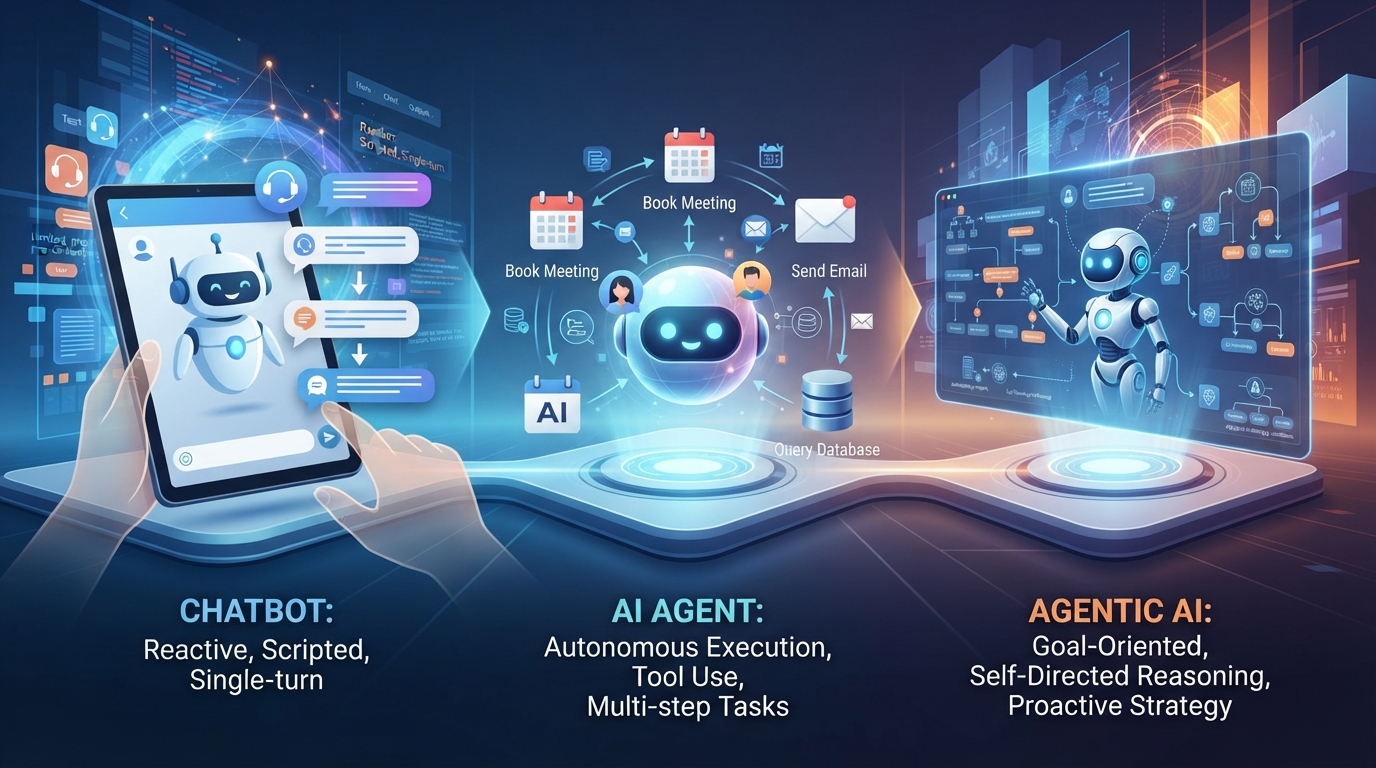
A chatbot answers questions using predefined rules or a fixed knowledge base. It’s reactive — it waits for input and responds within a script. Ask it something outside that script (“What are your business hours?” works; “Can you also rebook my appointment for next week?” usually doesn’t) and it stalls or hands off to a human.
An AI agent is a step up: give it a goal, and it works out the steps needed to reach it, selecting tools and executing a multi-step process without constant hand-holding. A request like “process a refund for order #12345” might involve the agent checking order status, validating it against policy, processing the payment, and sending a confirmation — one goal, several autonomous steps.
Agentic AI is the broader system built from multiple specialized agents working together, coordinating, self-correcting, and adapting with minimal human supervision. According to IBM’s explainer on agentic AI, these systems exhibit autonomy, goal-driven behavior, and adaptability that goes well beyond traditional, predefined AI models. Planning and executing an entire marketing campaign — research, content creation, scheduling, performance analysis, and optimization — is a task for an agentic AI system, not a single agent or a chatbot.
Step-by-Step Guide: Choosing the Right Tool for Your Work
Step 1: Map the Actual Task Before Shopping for Tools
What to do: Write down exactly what you want automated, in plain language, before looking at any specific product.

How to do it: Describe the task as a single sentence goal (“answer common client questions,” “process routine refunds,” “run my entire content pipeline end to end”). Notice how many distinct steps and decisions that sentence actually implies.
Why it matters: The complexity of your actual task — not the marketing language on a product’s homepage — determines where it falls in the AI agent vs agentic AI spectrum. Buying agentic AI capability for a task a simple chatbot could handle wastes money and setup time.
Example: A freelancer wanting to answer “what services do you offer and what are your rates?” needs a chatbot, not an agent — there’s no multi-step action required, just an accurate, consistent response.
Step 2: Check Whether a Chatbot Is Genuinely Enough
What to do: Test whether your task can be fully answered from a fixed set of information, with no action required beyond providing that information.

How to do it: List the most common questions or requests you receive. If every one of them can be answered with a lookup from existing information — pricing, hours, policies, FAQs — a chatbot is the right, and cheapest, tool.
Why it matters: Chatbots are the simplest and generally least expensive option. Starting here and only moving up the complexity ladder when genuinely necessary avoids over-engineering a simple problem.
Example: A freelance photographer fielding repeated “do you travel for shoots?” and “what’s included in the package?” questions can resolve both with a well-built chatbot, with no need for anything more sophisticated.
Step 3: Identify Tasks That Need a Single AI Agent
What to do: Look for tasks that involve a clear goal and several dependent steps, but stay within one defined process.
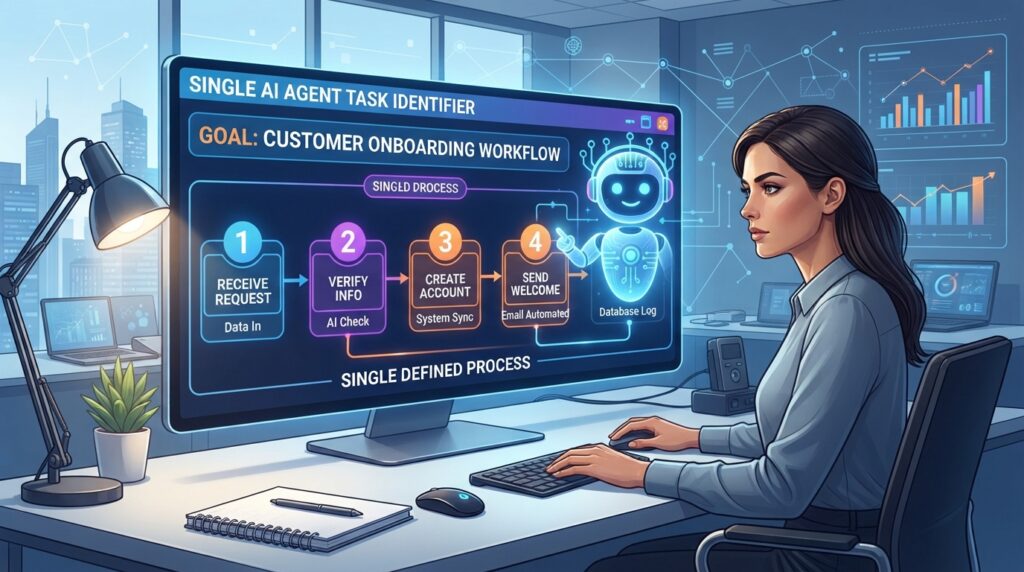
How to do it: Ask whether the task requires checking a status, applying a rule, taking an action, and confirming the result — all for one specific, bounded outcome. If so, this is AI agent territory, not chatbot or full agentic AI territory.
Why it matters: This is the layer where most freelancers and small businesses get the most practical value without the added complexity (and cost) of coordinating multiple specialized agents.
Example: An e-commerce freelancer automating order refunds — checking eligibility, applying the correct policy, processing payment, and emailing confirmation — is a textbook single AI agent use case.
Step 4: Recognize When You Actually Need Agentic AI
What to do: Identify whether your task genuinely requires multiple specialized processes working together, adapting to each other’s output in real time.
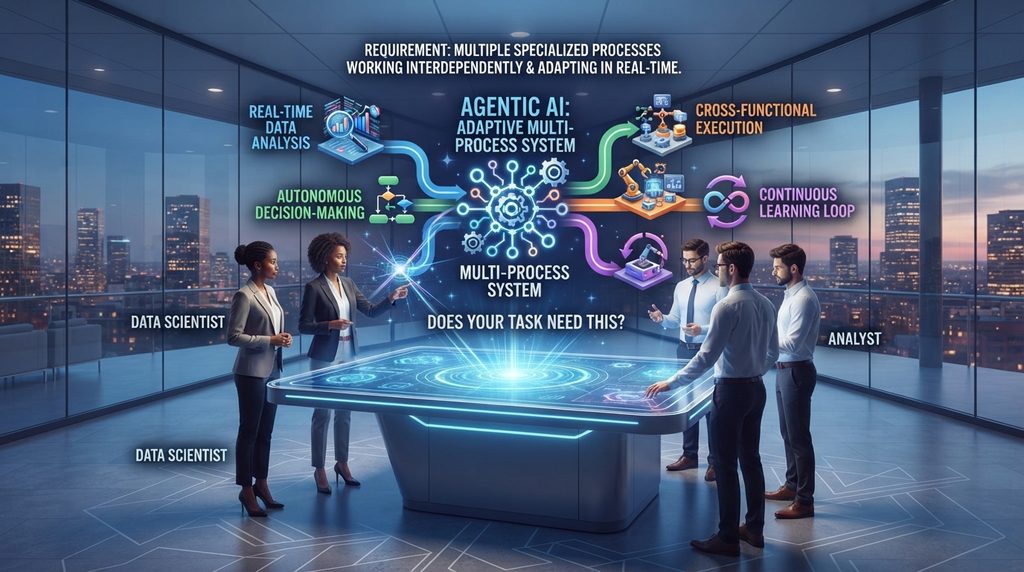
How to do it: Look for a task that can’t be reduced to one bounded workflow — instead, it involves several distinct sub-processes (research, content creation, scheduling, analysis) that each need to inform the next, with the system adjusting its own plan along the way.
Why it matters: This is the most powerful but also the most complex and least predictable layer of the AI agent vs agentic AI spectrum. It genuinely solves bigger problems, but it also requires more setup, oversight, and tolerance for unpredictable behavior than a single agent or chatbot.
Example: A solo marketer running an agentic AI system that researches a topic, drafts content, schedules publication, tracks performance, and adjusts future content based on results is coordinating several specialized functions — not one single task.
Step 5: Pilot Before You Commit
What to do: Run any new chatbot, agent, or agentic AI tool on a limited, low-stakes version of the real task before relying on it fully.
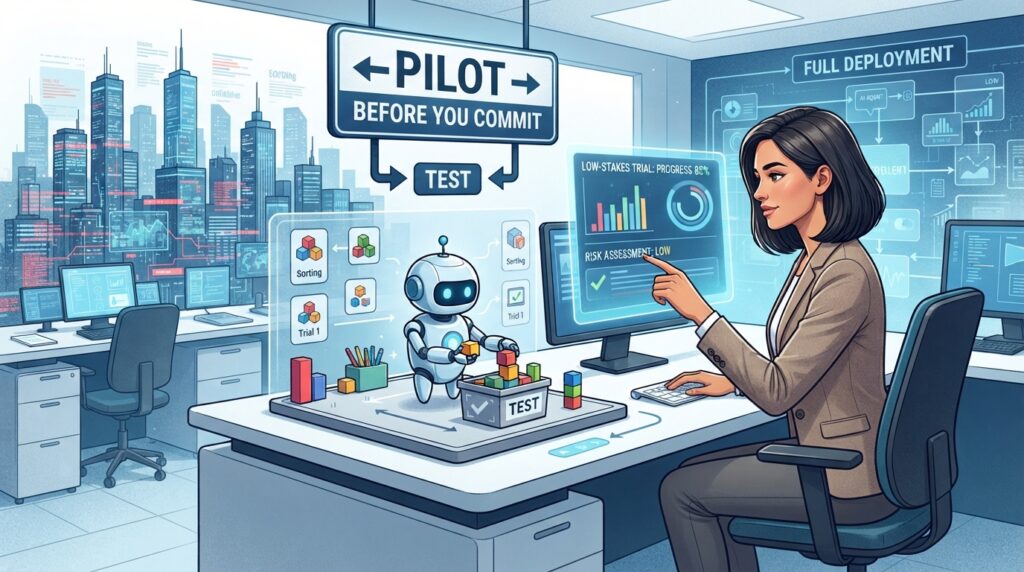
How to do it: Choose a small, reversible test case — a handful of client inquiries, a single week of scheduling, one marketing campaign segment — and monitor the output closely before scaling it to your full workload.
Why it matters: The more autonomy a system has, the more it can get wrong without you noticing immediately. A pilot period catches problems — bad refund logic, miscommunicated brand tone, an agent misreading an instruction — while the stakes are still low, no matter where the tool sits on the AI agent vs agentic AI spectrum.
Example: Before letting an AI agent process all refund requests automatically, a freelancer might run it alongside manual review for two weeks, comparing its decisions against what they would have done themselves.
Step 6: Set Clear Guardrails Proportional to Autonomy
What to do: Define explicit limits on what any AI agent or agentic AI system is allowed to do without human approval.
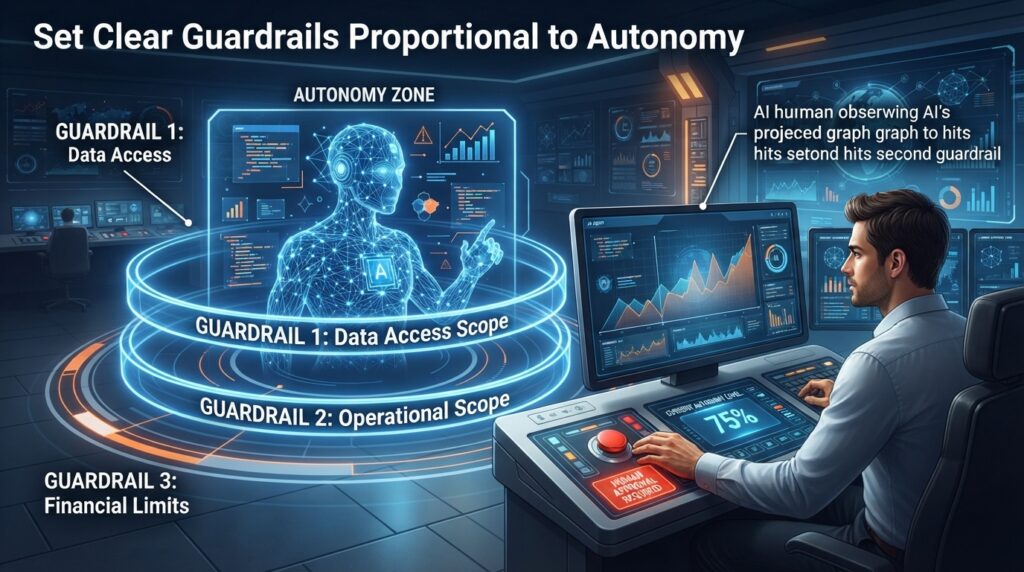
How to do it: For agent-level tasks, set spending caps, require approval above a certain threshold, or restrict actions to a defined list. For agentic AI systems, build in checkpoints where a human reviews output before it goes live or gets published.
Why it matters: The further up the AI agent vs agentic AI spectrum you go, the more independently the system acts — which means the cost of an undetected error scales up too. Guardrails are what make increasing autonomy safe to adopt.
If you’re evaluating these tools as part of a bigger automation setup, it’s worth reviewing our broader AI automation guides for freelancers to see how chatbots, agents, and agentic systems fit alongside your existing workflow tools.
Step 7: Reassess as Your Needs Grow
What to do: Revisit your tool choice periodically rather than assuming today’s decision is permanent.

How to do it: As your business or workload grows in complexity, repeat Steps 1 through 4 — a chatbot that was sufficient a year ago might now be hiding a real need for a single AI agent, or an agent-level task might have grown into something that needs full agentic AI coordination.
Why it matters: Needs change, and tools built for a simpler stage of your business can quietly become a bottleneck if you don’t periodically check whether they still fit.
Common Mistakes to Avoid
- Buying agentic AI capability for a chatbot-level problem. As Step 1 covers, the task’s actual complexity should drive the decision, not a vendor’s marketing language.
- Treating “AI agent” and “agentic AI” as interchangeable marketing terms. This confusion, highlighted throughout the AI agent vs agentic AI comparison, leads to mismatched expectations about what a tool can actually do unsupervised.
- Skipping the pilot phase. Jumping straight to full automation without a low-stakes test run means errors surface at scale instead of early and cheaply.
- Setting no guardrails on autonomous systems. The more independently a system acts, the more important explicit limits become — not less.
- Assuming a single tool choice is permanent. As Step 7 covers, needs evolve, and the right tool for last year’s workload may not fit this year’s.
Useful Tips for Beginners
- Start with the simplest tool that solves your actual problem — complexity should be earned by the task, not assumed from the start.
- Keep a running log of edge cases any chatbot or agent fails to handle — these are early signals that you may need to move up a level.
- When testing an AI agent, review its decision trail, not just its final output, so you understand how it reached a conclusion.
- For agentic AI systems, build in a regular human review checkpoint, even after the pilot period ends, since autonomous systems can drift over time.
- Don’t assume more autonomy always means more value — sometimes a well-built chatbot genuinely outperforms an overcomplicated agent for a simple, repetitive task.
Frequently Asked Questions
1. Is agentic AI always better than a single AI agent? No. Agentic AI solves more complex, multi-process problems, but it also comes with more setup complexity and less predictability. For a single, bounded task, one AI agent is often the more practical and reliable choice.
2. Can a chatbot be upgraded into an AI agent later? Often yes, depending on the platform. Many modern tools let you start with simple rule-based responses and progressively add agent-like capabilities (like taking actions, not just answering) as your needs grow.
3. Do I need technical skills to set up either side of the AI agent vs agentic AI spectrum? It varies by platform. Many no-code and low-code tools now support agent-level automation without programming, though agentic AI systems coordinating multiple agents often require more technical setup or a dedicated platform.
4. Will AI agents replace the need for human oversight entirely? No. Even well-designed agents and agentic AI systems benefit from human review, particularly for decisions involving money, client communication, or brand reputation, as covered in Steps 5 and 6.
5. How do I know if my business is too small for agentic AI? Size matters less than task complexity. A solo freelancer running a genuinely multi-step, adaptive process (like an end-to-end content pipeline) can benefit from agentic AI, while a larger business with mostly simple, repetitive questions may only need a chatbot.
Final Thoughts

The real AI agent vs agentic AI distinction comes down to scope and autonomy: a chatbot answers within a script, an AI agent executes a bounded multi-step goal, and agentic AI coordinates multiple specialized processes with minimal supervision. None of these is universally “better” — the right choice depends entirely on how complex your actual task is.
Start by mapping one real task from your own work using Step 1, and test it against the simplest tool first. That practical exercise will tell you more about which category you actually need than any product comparison chart.