

How to Build a Freelance Portfolio With No Experience
Clients rarely hire a freelancer they know nothing about. They want proof that you can do the work, and that proof usually lives in a portfolio. The problem is that most beginners feel stuck: you need a portfolio to win clients, but you need clients to build a portfolio.
The good news is that you can break this cycle. A freelance portfolio with no experience is possible when you create your own proof, use the work you can legitimately share, and present it clearly. You don’t need years of paid projects. You need a focused set of examples, honest descriptions, and an easy way for people to find and contact you.
This guide walks you through the process one step at a time. Each step explains what to do, how to do it, and why it matters. Work through them in order. The early steps give you material, and the later steps turn that material into something clients can trust.
What Is a Freelance Portfolio With No Experience?

A freelance portfolio is a collection of work that shows what you can deliver. It can be a website, a PDF, a profile on a design or writing platform, or a simple shared document. Clients use it to judge your skill, style, and reliability before they hire you.
A portfolio with no experience is one built without a history of paid client work. Instead of case studies from past employers, it includes sample projects, practice pieces, volunteer work, and small trial projects. The format is the same, but the source of the work is different.
Clients care less about where the work came from and more about whether it solves a problem. A clear sample project that shows your process, your decisions, and your results can persuade a buyer far more than a vague list of skills.
Be honest about what the work is. Label sample projects as sample projects. Don’t claim a client relationship you don’t have, and don’t invent testimonials. Trust is the foundation of a freelance business, and a portfolio is often the first place a client forms an opinion of it.
Step-by-Step Guide
Work through these steps in order. Each one builds on the last, so skipping ahead usually means rework later.
Step 1: Choose One Service and One Niche

What to do: Pick the single service you want to sell first, such as copywriting, logo design, video editing, bookkeeping, or web development. Then choose a type of client to focus on, such as local cafés, online course creators, or small law firms.
How to do it: Write one sentence in this format: “I help [type of client] with [specific service] so they can [outcome].” For example: “I help small online shops write product descriptions so they can explain their range more clearly.”
Why it matters: A portfolio that tries to show everything looks unfocused. A clear niche tells clients exactly who you help, and it makes your sample projects easier to choose and easier to understand.
Example: A beginner graphic designer decides to focus on social media graphics for independent fitness coaches. Every sample she builds from that point on speaks to that audience.
Step 2: Create Three to Five Sample Projects
What to do: Make three to five projects that show the kind of work clients would pay for.
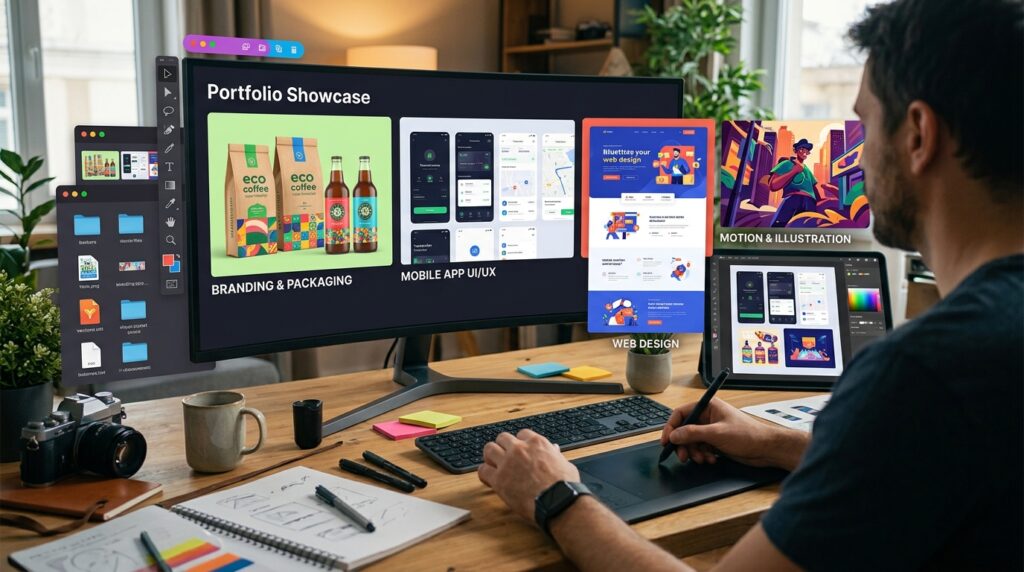
How to do it: Choose realistic briefs. Invent a business, write a short brief with a goal and audience, and then complete the work. Include a range of formats if your field allows it, such as a long-form article, a short landing page, and a social post series. Save each project in a format you can share easily.
Why it matters: Sample projects replace the missing client history. They prove you can follow a brief, meet a deadline you set yourself, and produce work that looks professional.
Example: A beginner copywriter invents a small bakery in Auckland, writes its website homepage, three product descriptions, and a month of social captions. She presents the brief at the top of each piece so readers can see the goal.
Step 3: Use Real Work Where You Legitimately Can

What to do: Look for real work you can share with permission, such as volunteer projects, small favours for a local business, or work for a friend’s organisation.
How to do it: Offer a clear, limited scope and agree in writing what you can publish. Ask for permission to share the work, and if you can’t share the final version, describe your contribution in words and show anonymised visuals. Keep the agreement simple. A short email confirming the scope is usually enough for a small project.
Why it matters: Real work carries more weight than a sample, because it shows that someone else trusted you. It also gives you a useful first experience with client communication, deadlines, and feedback.
Example: A beginner web developer offers to rebuild the booking page for a local yoga studio for free, in exchange for a testimonial and permission to show a screenshot. The scope is limited to one page, and both sides agree on it in writing first.
Step 4: Write a Case Study for Each Project
What to do: Turn each project into a short case study that explains the problem, your approach, and the outcome.
How to do it: Use four short headings: the brief, the challenge, what you did, and the result. Under “result,” describe what changed or what you learned. If the project is a sample, say so, and describe the outcome you measured, such as clarity, readability score, or a test audience’s feedback. Don’t invent figures.
Why it matters: Clients buy outcomes. A case study shows your thinking, not just your finished output, and it answers the question every buyer has: “Can this person solve my problem?”
Example: A beginner social media manager writes a case study about a sample campaign. She explains that the brief was to increase saves on a recipe account, describes her three post formats, and shares the results from a small test with five friends who follow similar accounts. She labels the test clearly as small and informal.
Step 5: Build a Simple Home for Your Work

What to do: Create one central place where clients can see your portfolio. This could be a personal website, a portfolio page on a design or writing platform, or a well-organised PDF.
How to do it: Keep the layout simple. Put your strongest project first, your service and niche near the top, and your case studies one click away. Make sure the page loads quickly on a phone, uses readable text, and can be found by search engines. Check that the page isn’t blocked from indexing if you want people to find it online, and submit your site to Google Search Console if you have a website.
Why it matters: A portfolio that nobody can open or find doesn’t work. Basic technical access comes first. If a search crawler can’t read your page, nothing else on it can help you get discovered.
Example: A freelance editor builds a one-page site with a clear headline, three case studies, and a contact button. She checks the page on her phone and confirms that it appears when she searches for her own name and niche.
Step 6: Make Your Profiles Tell the Same Story

What to do: Update your LinkedIn profile, freelance platform bios, and any social accounts so they describe the same service and niche.
How to do it: Use the same headline, the same short description, and the same links across platforms. Adjust tone to suit each site, but keep the core message consistent. If you offer three services, choose the one you want to lead with and mention it first everywhere.
Why it matters: Inconsistent profiles make you look like several different people. Clients who see a copywriter on one site and a video editor on another may not know what to expect, and they may move on.
Example: A beginner UX designer uses the headline “UX designer for small healthcare clinics” on his website, LinkedIn, and freelance profile. Each profile then links to the same portfolio page.
Step 7: Make It Easy to Say Yes

What to do: Add a clear call to action near the top of your portfolio and at the end of every case study.
How to do it: Use one simple action, such as “Book a 20-minute call” or “Email me a short brief.” State what happens next, such as “I reply within two working days.” Keep the contact form short, with no more than three fields.
Why it matters: Visitors who like your work still leave if they have to hunt for a way to contact you. A direct next step turns interest into enquiries.
Example: A beginner translator adds a line under each case study that reads “Send me your document and I’ll reply with a quote within one working day.” Enquiries start arriving from people who had already read the relevant sample.
Common Mistakes to Avoid

Showing too much work. A portfolio with 30 mixed samples overwhelms visitors. Show three to five strong pieces that match your niche, and remove anything weaker.
Inventing clients or testimonials. This damages trust quickly. Label sample work clearly, and only quote people who have genuinely given feedback.
Leaving out the process. A finished image or document tells part of the story. Add a few lines explaining your brief, decisions, and results.
Hiding your contact details. If people can’t reach you within a few seconds, they will look elsewhere. Place your contact option near the top.
Ignoring page speed and mobile layout. Many visitors open portfolios on phones. Test your page on a small screen before you share it.
Waiting until you feel ready. Publish a focused portfolio, then improve it as real work arrives. A strong starting point beats a perfect page that never goes live.
Useful Tips
- Start with one niche. You can widen your focus later, once you have clients and results to show.
- Write your brief first. A short brief at the top of each sample makes your thinking visible.
- Ask for feedback. Share your portfolio with two or three working freelancers and ask what is unclear.
- Update every quarter. Replace weaker samples with better ones as you improve.
- Keep copies of everything. Save final files and drafts in a folder so you can show your process later.
- Check local rules. Registration, tax, and invoicing rules for freelancers vary by country. Review official guidance such as the GOV.UK page linked above, or your national tax authority’s website.
- Treat early rates as a test. Your first projects are for learning. Adjust your pricing as your skills and evidence grow.
Frequently Asked Questions
How many samples do I need in a freelance portfolio with no experience?
Three to five strong samples are usually enough to start. Quality and relevance matter more than quantity, so choose pieces that match the service you want to sell.
Can I use free or volunteer work in my portfolio?
Yes, if you have permission to share it and describe the scope accurately. Make clear that the work was free or voluntary, and focus on what you delivered.
Do I need a website to build a freelance portfolio with no experience?
Not always. A profile on a relevant platform, a PDF, or a shared document can work at the start. A personal website gives you more control, so consider adding one once you have a few pieces ready.
How long does it take to build a portfolio?
It depends on your skill level, time, and the type of work. A small focused portfolio can often be prepared in a few weeks of part-time effort. Treat any timeline as an estimate, and expect to update it over time.
Final Thoughts

A strong freelance portfolio with no experience doesn’t depend on a long client list. It depends on focus, honesty, and clear proof of your ability. Choose one service and niche, create sample projects, use real work where you can, write simple case studies, publish a findable home for your work, align your profiles, and make it easy for people to get in touch.
Start at the top and work your way down. Each step makes the next one easier.
Your next practical step is small. Today, write your one-sentence service statement, then choose the first sample project you will build this week.
you can start with this freelance platforms.
Fiverr, Upwork, and PeoplePerHour
Click this link to read our important and interesting Technology articles as soon as they are published!