
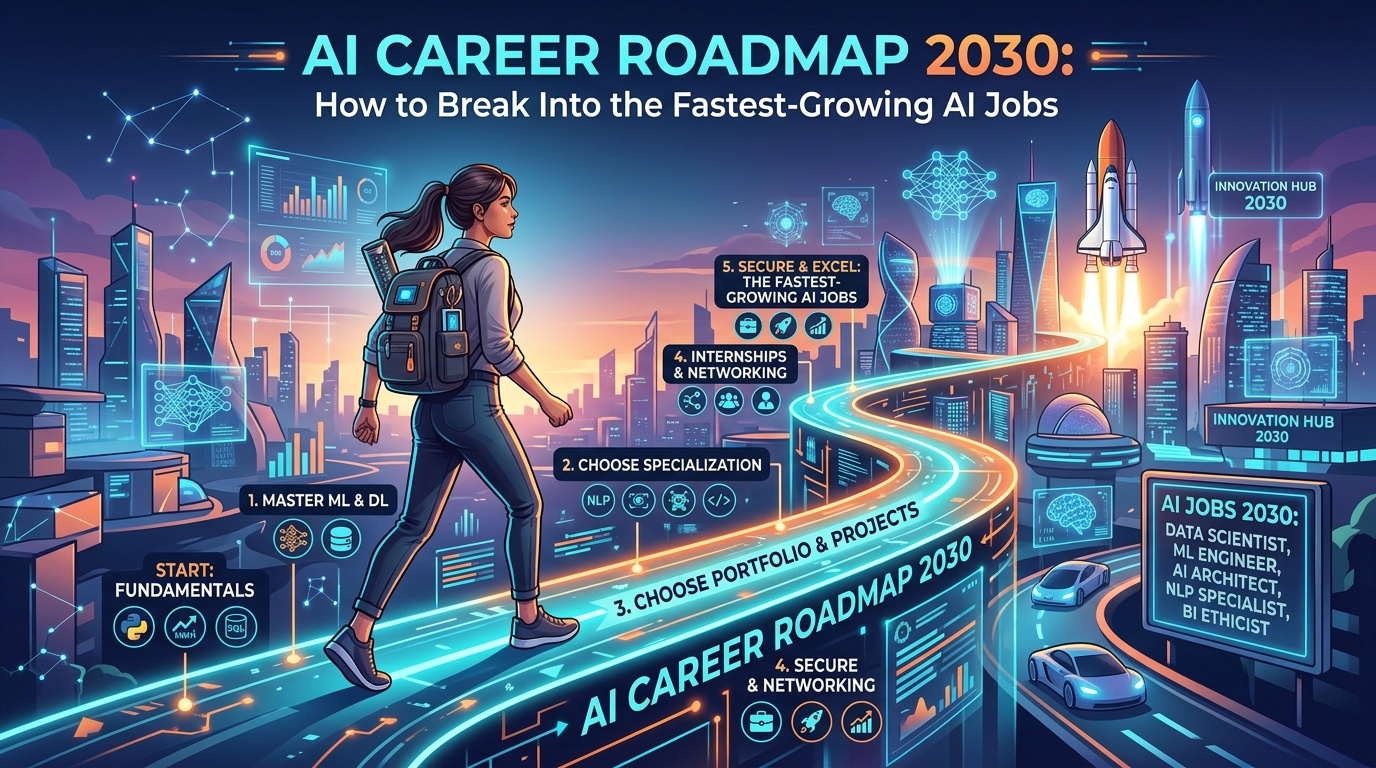
AI Career Roadmap 2030: How to Break Into the Fastest-Growing AI Jobs
By 2030, the global job market is set for a significant shake-up. According to the World Economic Forum’s Future of Jobs Report 2025, 170 million new roles are expected to be created worldwide, while 92 million existing positions are projected to be displaced — a net disruption touching roughly 22% of jobs globally. AI and automation sit at the center of that shift.
That’s a lot of change to process, and it’s easy to either panic or tune it out entirely. Neither reaction is useful. What actually helps is a clear AI career roadmap — a practical understanding of which roles are growing, what separates them from one another, and a realistic starting point if you want to move toward one of them, whether you’re a job seeker, a freelancer adding new skills, or a remote professional planning your next move.
This guide breaks down the fastest-growing AI-related roles, explains what genuinely separates them, and lays out a step-by-step path for building toward one — without promising outcomes no one can guarantee.
What Is an AI Career Roadmap?
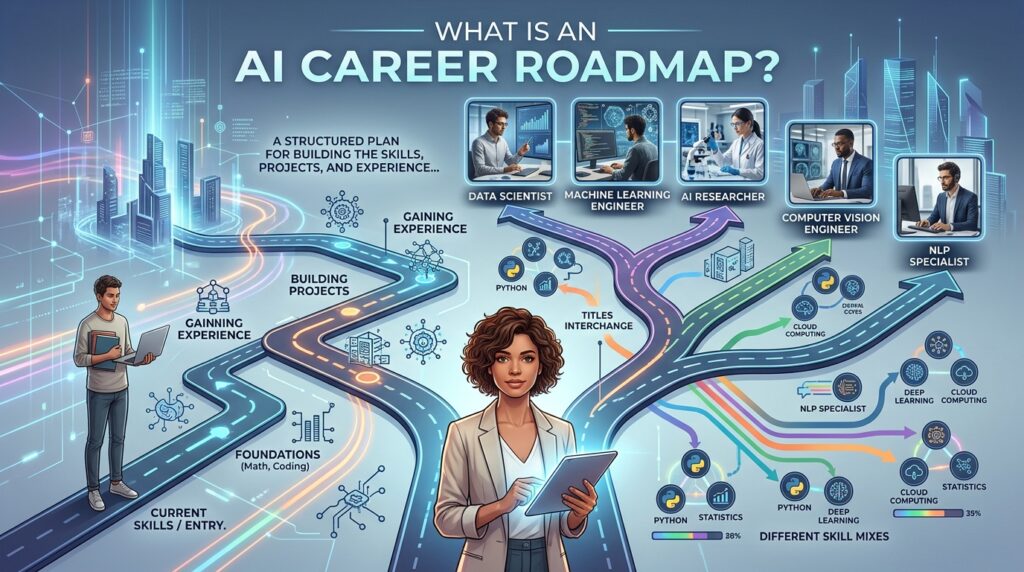
An AI career roadmap is a structured plan for building the skills, projects, and experience needed to move into an AI-related role — rather than trying to learn everything about artificial intelligence at once, which is neither realistic nor necessary.
The AI job market isn’t one single career path. It’s a cluster of related but distinct roles, each requiring a different mix of skills. Before committing time to any of them, it helps to understand what actually separates one from another, since the titles get used loosely and inconsistently across job postings.
The Fastest-Growing AI Roles, Explained
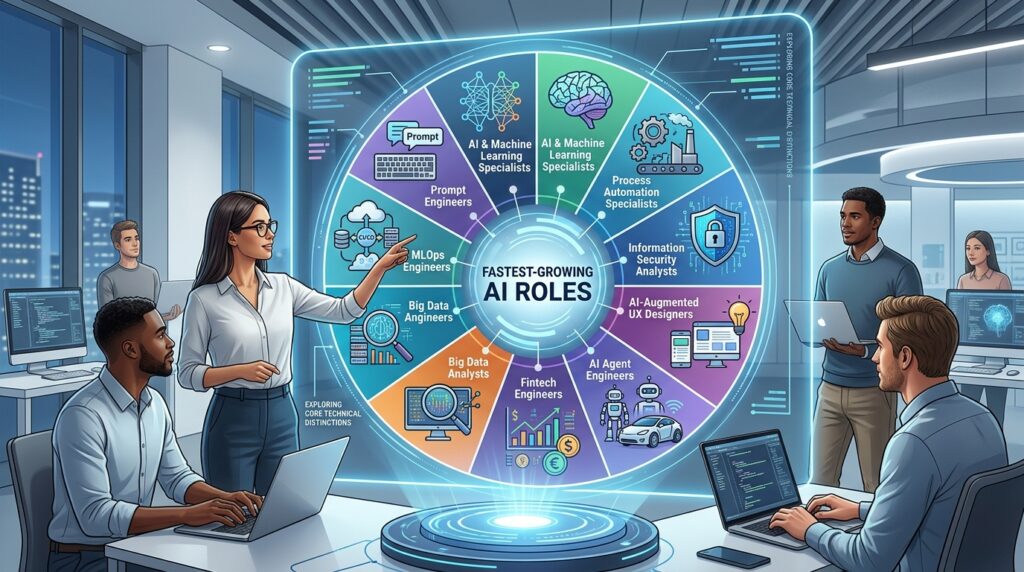
Based on current industry trends, several AI-related roles are seeing particularly strong demand: AI and machine learning specialists, process automation specialists, information security analysts, AI-augmented UX designers, AI agent engineers, fintech engineers, big data analysts, MLOps engineers, and prompt engineers. Here’s what actually separates the core technical roles among them:
- AI Engineer — applies existing AI models to real-world products, like chatbots or recommendation systems. Think: building smart features into an app.
- ML Engineer — builds, trains, and deploys machine learning models at scale. Think: the pipelines and infrastructure behind a model, not just the model itself.
- Data Engineer — builds and maintains the data pipelines that keep information clean and accessible. Think: the backbone that every AI system depends on.
- MLOps Engineer — deploys and monitors machine learning models once they’re in production. Think: DevOps practices applied specifically to AI systems.
- AI Agent Engineer — builds autonomous systems that can reason, plan, and take multi-step actions with limited human input. Think: agent-based workflows rather than single-response tools.
- Prompt Engineer — crafts and refines prompts to get more reliable, useful output from large language models. Think: a specialized communication skill applied to AI systems.
- NLP Engineer — works specifically on language-based tasks: summarization, translation, question-answering. Think: text-focused AI work.
- Computer Vision Engineer — focuses on getting machines to interpret images and video. Think: object detection, facial recognition, optical character recognition.
Understanding these distinctions matters because a generic “I want to work in AI” goal is much harder to act on than “I want to become a data engineer” — the latter tells you exactly which skills to prioritize first.
Step-by-Step Guide: Building Your Path Into AI
Step 1: Learn the Fundamentals First
What to do: Before specializing in any single AI role, build a solid base in the skills nearly every AI-related path requires.
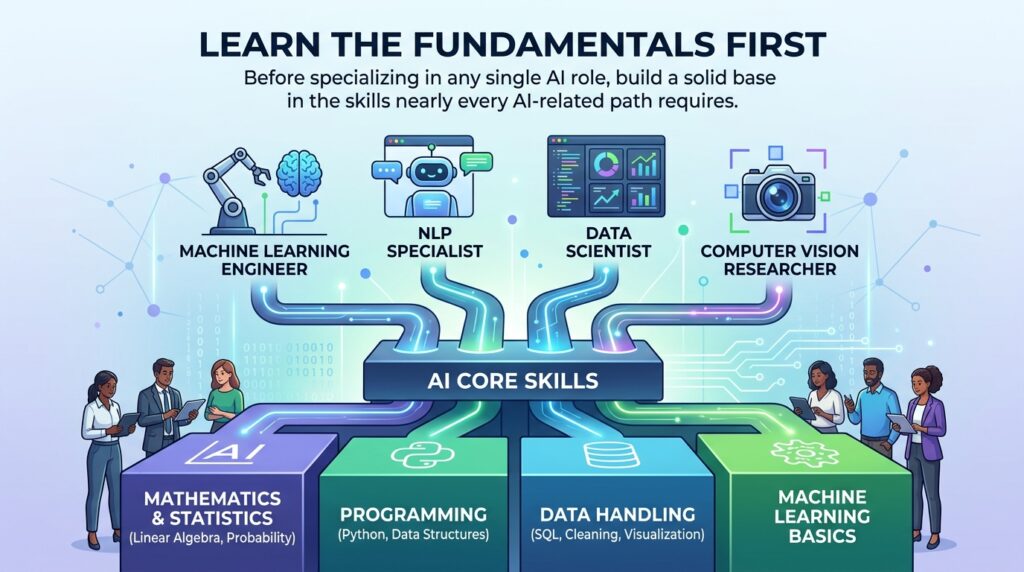
How to do it: Focus on three areas: Python programming, core data structures and algorithms, and foundational math — specifically linear algebra, probability, and statistics. Free resources like university-published courses (MIT OpenCourseWare, for example) and structured platforms like Coursera or freeCodeCamp cover all three well.
Why it matters: Skipping straight to a specialized tool or framework without these fundamentals tends to create a shaky foundation — you can follow a tutorial, but you’ll struggle to adapt when a real project doesn’t match the tutorial exactly.
Example: Someone aiming to become a Prompt Engineer might assume math isn’t relevant to their path, but understanding basic probability still helps in reasoning about how language models generate and rank responses.
Step 2: Pick a Direction Based on What You Actually Enjoy
What to do: Use the role breakdown above to choose an initial direction — AI, ML, data, or a more specialized path like NLP or computer vision.
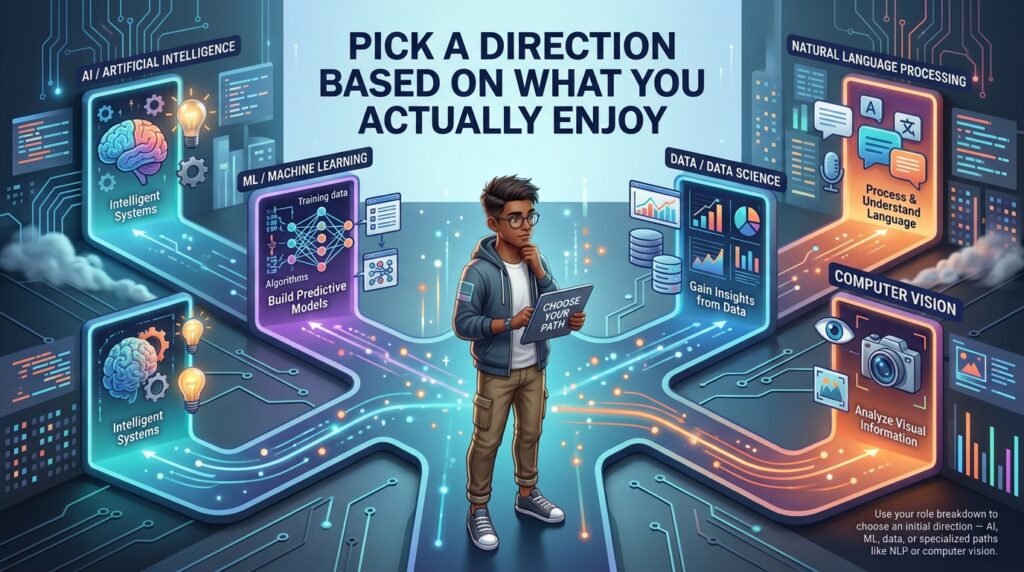
How to do it: Rather than choosing based on salary rumors or trending headlines, spend a few weeks exploring small projects or free introductory courses across two or three of these areas before committing. Internships, if accessible to you, are also a low-risk way to test a direction before fully committing.
Why it matters: Any AI career roadmap built purely on what’s “hot” right now risks losing motivation quickly if the day-to-day work doesn’t actually suit you. Genuine interest sustains the long hours that skill-building requires far better than chasing a trend.
Example: Someone who enjoys visual, hands-on problem-solving might find Computer Vision work more engaging than the more abstract, infrastructure-heavy world of MLOps — even if MLOps postings currently outnumber computer vision ones in their region.
Step 3: Build Real Projects, Not Just Course Certificates
What to do: Move from tutorials to independent projects as soon as you have basic fundamentals in place.
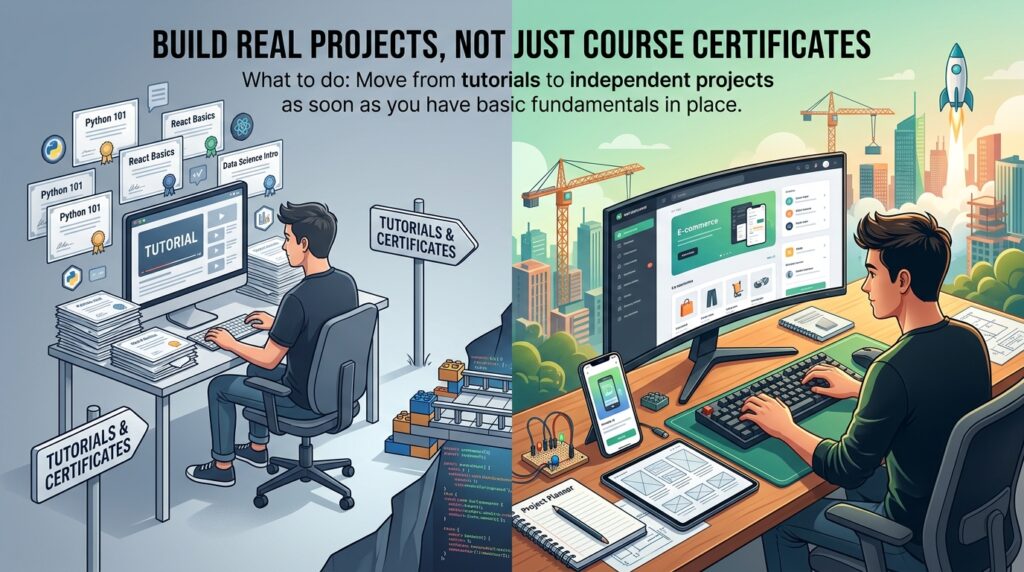
How to do it: Build things like a simple chatbot, a basic recommendation system, a resume parser, a small data pipeline, or an agent built with a framework like LangChain. Keep each project scoped small enough to actually finish.
Why it matters: Employers and clients consistently value demonstrated, working projects over course completion certificates alone. A certificate shows you sat through material; a finished project shows you can apply it.
Example: A finished, even simple, GPT-powered customer support bot on your GitHub says more to a hiring manager than a list of five completed online courses with no visible output.
Step 4: Learn the Tools Actually Used in the Field
What to do: Once you have a direction, learn the specific tools professionals in that area actually use day to day.
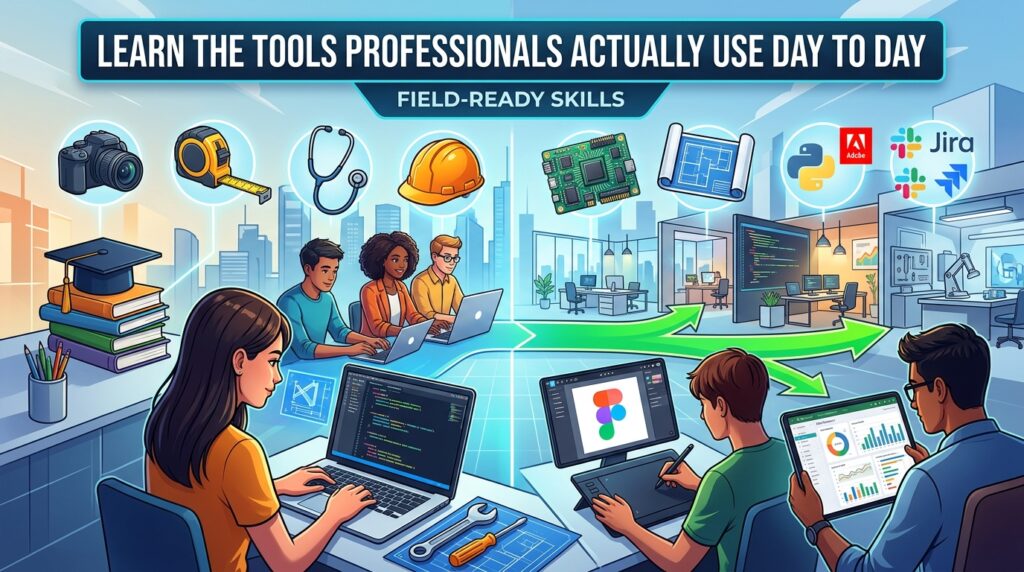
How to do it: Depending on your path:
- AI/ML: Scikit-learn, TensorFlow, PyTorch
- Data: SQL, Spark, Airflow
- LLM-focused work: LangChain, OpenAI’s API and documentation
- Deployment/DevOps: Docker, Kubernetes, Git
Why it matters: Concepts alone won’t get you through a technical interview or a real project. Tool fluency is what separates someone who understands AI in theory from someone who can actually contribute to a team’s existing workflow.
Step 5: Share Your Work Publicly
What to do: Start posting your projects, notes, and progress somewhere visible — GitHub, Kaggle, or LinkedIn.
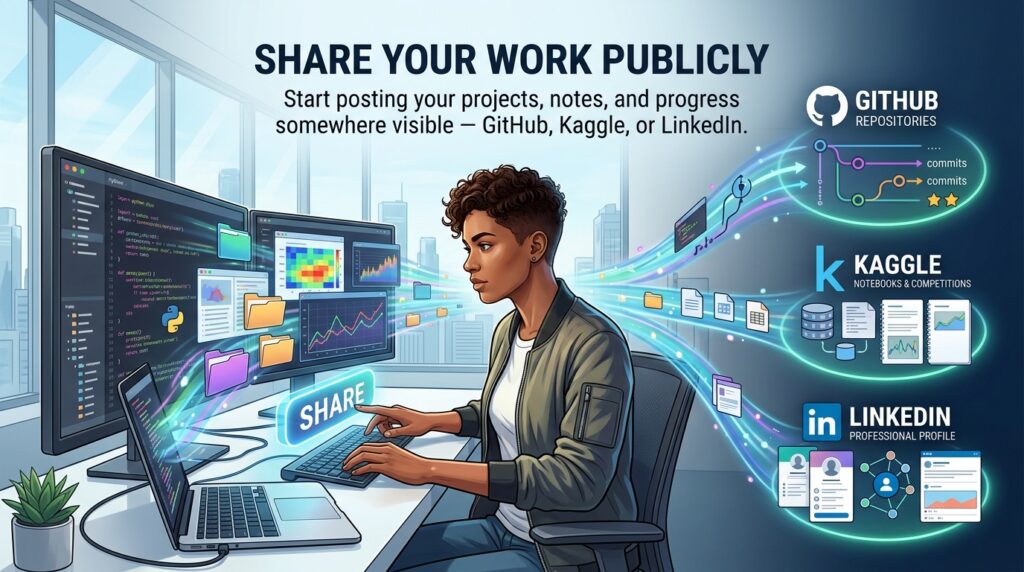
How to do it: Keep it simple and consistent: a clean GitHub repository with a clear README, a Kaggle notebook explaining your approach, or a short LinkedIn post about what you built and what you learned from it.
Why it matters: Any AI career roadmap that stays entirely private makes it harder for employers, clients, or collaborators to discover your work. Visible, documented progress also builds a track record you can point to later, beyond just listing skills on a résumé.
Example: A recruiter searching GitHub for candidates with hands-on LangChain experience is far more likely to find someone with three small public projects than someone with the same skills but no public record of them.
Step 6: Join Communities and Ask Questions
What to do: Get involved in spaces where people working in AI actually discuss problems and share resources.

How to do it: Join relevant Discord servers, attend local or virtual meetups, and contribute to open-source projects where you can, even in small ways like fixing documentation or reporting bugs.
Why it matters: Learning in isolation is slower and more discouraging than learning alongside others facing the same problems. Communities also surface job leads and collaboration opportunities that rarely show up in a standard job search.
Example: A question posted in an active ML Discord server about a confusing error message often gets answered faster and more usefully than the same question searched alone.
Step 7: Document and Share Your Journey
What to do: Treat your learning process itself as part of your professional presence, not just the finished skills.
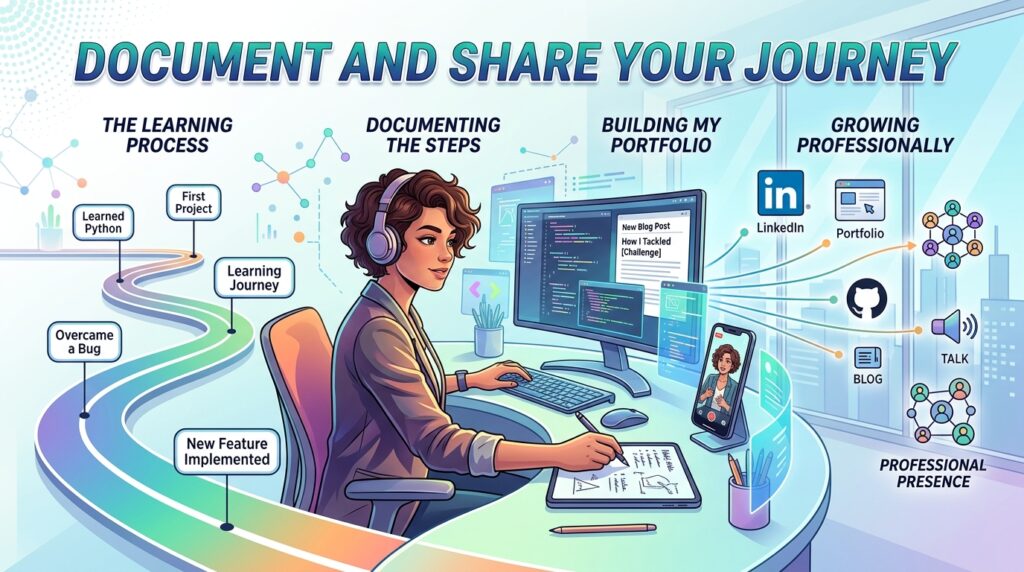
How to do it: Post periodic updates about what you’re learning, what you’re struggling with, and what you’ve built — even before you feel like an “expert.” A short monthly post is more sustainable than trying to produce polished content constantly.
Why it matters: Personal visibility has become a meaningful part of how people find opportunities in tech fields, including AI. Consistently sharing your process — not just final results — makes your AI career roadmap visible to people who might later become collaborators, clients, or employers. If you’re managing this kind of skill-building alongside other career or freelance goals, our digital career resources for job seekers cover related tools worth exploring.
Common Mistakes to Avoid
- Trying to learn everything at once. Attempting to master AI, ML, data engineering, and prompt engineering simultaneously usually leads to shallow knowledge across the board rather than real depth in one area.
- Skipping fundamentals to jump straight into trendy tools. As Step 1 covers, weak fundamentals eventually show up as a ceiling on how far you can progress.
- Collecting certificates without building anything. Certificates alone rarely demonstrate applied skill the way a working project does.
- Comparing your progress to unrealistic online success stories. Many “went from zero to AI engineer in three months” posts leave out prior experience, existing connections, or particularly favorable circumstances.
- Staying completely private about your work. As Step 5 and Step 7 cover, visibility is part of how opportunities find you in this field — not a vanity exercise.
Useful Tips for Beginners
- Pick one project at a time and finish it before starting the next — half-finished projects rarely make it onto a portfolio.
- Use free-tier tools first (Google Colab, free API tiers) before paying for anything, since many fundamentals can be learned without cost.
- Read the original World Economic Forum Future of Jobs Report 2025 directly rather than relying only on secondhand summaries of its findings.
- Revisit your chosen direction every few months — it’s normal and reasonable to adjust your AI career roadmap as you learn more about what you actually enjoy.
- Balance technical skill-building with the “human skills” — communication, adaptability, critical thinking — that the WEF report also identifies as increasingly valued alongside technical AI skills.
Frequently Asked Questions
1. Do I need a computer science degree to follow an AI career roadmap? Not necessarily. Many professionals in AI-adjacent roles come from non-traditional backgrounds, though a strong grasp of the fundamentals from Step 1 is still important regardless of formal education. Some employers do still prefer or require a relevant degree, so check specific role requirements in your target market.
2. How long does it typically take to become job-ready in an AI-related role? This varies widely based on your starting point, the specific role, and how much time you can consistently dedicate. There’s no fixed guaranteed timeline, and claims of extremely fast transitions often don’t reflect a typical starting point.
3. Which AI role is easiest to break into as a beginner? Prompt Engineering and AI-augmented roles built on existing tools (rather than building models from scratch) often have a somewhat lower technical barrier to entry, though “easier” still requires genuine, consistent skill-building rather than a shortcut.
4. Will following this roadmap guarantee me a job in AI? No. A clear roadmap improves your odds by building real, demonstrable skills, but hiring outcomes depend on many factors outside your control, including regional job markets, employer needs, and overall economic conditions.
5. Is it too late to start if I don’t already have technical experience? The WEF’s 22% job disruption figure reflects a multi-year shift through 2030, not a closing window. Starting now, even from zero technical background, still leaves meaningful time to build real skills before that shift fully plays out.
Final Thoughts
The roles making up today’s AI job market aren’t as interchangeable as they might first appear, and understanding those differences is the real starting point of any useful AI career roadmap. Learn the fundamentals, pick a direction based on genuine interest rather than hype, build real projects, and make your progress visible as you go.

Start with Step 1 this week — even an hour spent reviewing core Python or statistics fundamentals is a more useful starting point than trying to decide, right now, exactly which of the nine roles above is “the one.” Clarity tends to come from doing the work, not from planning it perfectly in advance.






That was amazing