

How to Write a Freelance Proposal That Wins Clients: Templates and Examples
A strong freelance proposal can be the difference between a client who says “let’s talk” and one who never replies. Many talented freelancers lose work not because their skills fall short, but because their proposals are vague, overly long, or focused on themselves instead of the client’s problem. Whether you’re a freelance designer, a remote developer, a virtual assistant, or a digital marketer building a side income, learning to write a clear proposal is one of the most practical skills you can develop. This guide walks you through a step-by-step process, shares templates you can adapt, and explains why each part of a proposal matters.
What Is a Freelance Proposal?

A freelance proposal is a document that explains how you will solve a client’s problem, what the work will include, how long it will take, and what it will cost. It’s the bridge between a first conversation and a signed agreement.
A good proposal does four things:
- It shows you understand the client’s goal.
- It explains your approach in plain language.
- It sets clear scope, timeline, and price.
- It makes the next step easy to take.
Proposals come in many forms. Some are short emails, others are formatted documents or pages sent through a proposal tool. The format matters less than the clarity. A two-paragraph email that answers the client’s real question can outperform a twenty-page document that doesn’t.
Step-by-Step Guide to Writing a Winning Proposal
Follow these steps in order. Each one builds on the last, and skipping the research step is the most common reason proposals fall flat.
Step 1: Research the Client Before You Write

What to do: Learn what the client needs, what they’ve tried, and what success looks like for them.
How to do it: Review their website, recent posts, product pages, and any case studies. Read the job post or inquiry carefully. Write down three things: the problem they’re trying to solve, the people affected by it, and the result they want. If you have a call, take notes on specific phrases the client uses.
Why it matters: Clients can tell when a proposal is generic. Showing that you’ve done your homework signals professionalism and builds trust before you’ve started the work.
Example: A freelance copywriter applying for a job at a skincare brand notices the company’s blog focuses on sustainable packaging. Her proposal opens with a sample headline idea for that topic, instead of a list of her past clients.
Step 2: Open With the Client’s Problem

What to do: Start your proposal by restating the challenge in your own words.
How to do it: Write one or two sentences that describe the client’s situation and the goal. Keep your own introduction for later. The first line should make the client think, “Yes, this person understands what I need.”
Why it matters: Clients read the opening most carefully. If the first thing they see is your résumé, they may stop reading before they reach your solution.
Example:
“Your team wants to increase trial sign-ups for your scheduling app, but the current landing page gets lots of visitors and few sign-ups. Here’s how I’d approach that.”
Step 3: Explain Your Approach Clearly
What to do: Describe how you’ll solve the problem in clear, concrete steps.

How to do it: Break the work into three to five phases, such as research, draft, revise, and deliver. Use plain language. Avoid jargon unless the client uses it themselves. Mention any tools or methods you’ll use, and explain why they fit.
Why it matters: A clear approach shows you have a plan. It also makes it easier for the client to picture working with you.
Example: A web developer proposing a site redesign might write: “Phase 1: review your current site analytics and top pages. Phase 2: create wireframes for the three highest-priority pages. Phase 3: build, test on mobile, and launch.”
Step 4: Define the Scope and Deliverables
What to do: State exactly what you’ll deliver.

How to do it: List each deliverable, such as “five blog posts of 1,200 words each” or “one logo with three colour variations.” Include what’s not included, such as unlimited revisions or ongoing maintenance. Mention the number of revision rounds you’ll offer.
Why it matters: Unclear scope causes most freelance disputes. Written deliverables protect both sides and prevent surprise requests.
Example: “Included: two rounds of revisions. Not included: social media posting, stock photo purchases, or additional rounds beyond the agreed two.”
Step 5: Set a Realistic Timeline

What to do: Show when each phase will be completed.
How to do it: Estimate the time for each phase, then add a small buffer for feedback and delays. Present the timeline as a simple list with start and finish dates or durations. Mention what the client needs to provide and by when, such as brand guidelines or approvals.
Why it matters: Clients want predictability. A timeline that depends on the client’s feedback also reminds them of their role in the project.
Example: “Week 1: research and outline. Week 2: first draft. Week 3: revisions after your feedback. Final delivery by the end of Week 3, assuming feedback arrives within three business days.”
Step 6: Present Your Pricing Options
What to do: Show your price in a clear, easy-to-compare way.
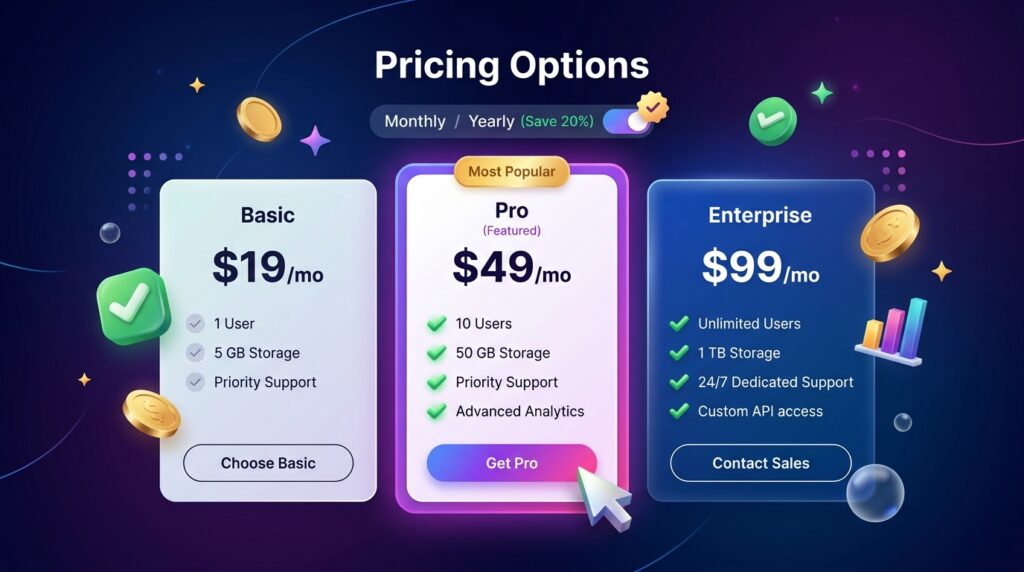
How to do it: You can offer a single fixed price, hourly rates with an estimated total, or two or three packages. Packages work well because they give clients a choice without making them negotiate from scratch. Make sure each option lists what it includes. If you’re unsure about your rates, check current local and industry benchmarks, and treat any figures you find as estimates rather than guarantees.
Why it matters: Pricing is often where proposals stall. Clear options make it easier for clients to say yes, and they show you’re organized.
Example:
- Basic: One landing page, one revision round.
- Standard: Landing page plus two supporting pages, two revision rounds.
- Premium: Full site of up to five pages, unlimited minor edits for 30 days after launch.
Step 7: Add Proof That You Can Deliver

What to do: Include relevant examples that prove your ability.
How to do it: Choose two or three samples that match the client’s industry or problem. Describe each in one or two sentences, focusing on the result. If you don’t have client work yet, use a sample project and say clearly that it’s a sample. Mention any credentials or tools that matter for this project.
Why it matters: Clients want evidence. Specific results are far more convincing than general claims like “I’m passionate about quality.”
Example: “For a B2B software company, I rewrote 12 help articles. Their support team reported fewer repeat questions in the following quarter.” Only use results you can verify, and avoid guarantees.
Step 8: End With a Clear Next Step

What to do: Tell the client exactly how to move forward.
How to do it: Close with a simple call to action, such as “Reply to confirm your preferred package, and I’ll send the contract and invoice within one business day.” Include your availability for a short call if that helps.
Why it matters: Proposals often fail because the next step is unclear. A specific action keeps momentum going.
Example: “If this approach works for you, reply with ‘Standard’ and I’ll send the agreement today.”
Templates You Can Adapt
Here’s a simple structure you can copy and personalize:
Subject: [Project name] proposal for [Client name]
Hi [Name],
Thanks for sharing the details about [project]. From what you described, the main goal is [client’s goal], and the challenge is [problem].
Here’s how I would approach it:
- [Phase 1 with a short description]
- [Phase 2 with a short description]
- [Phase 3 with a short description]
What’s included: [deliverables]
Timeline: [key dates or durations]
Investment: [package options or fixed price]
A recent example: [one or two sentences about a relevant result]
If this direction works for you, reply to confirm and I’ll send the agreement.
Best,
[Your name]
Adjust the tone to match the client. A startup may enjoy a friendly, direct style, while a law firm may prefer formal language.
Common Mistakes to Avoid
Many proposals lose clients for avoidable reasons. Watch for these:
- Starting with yourself. Solution: Lead with the client’s problem and goals.
- Sending the same proposal to everyone. Solution: Customize at least the opening, the approach, and the examples.
- Vague deliverables. Solution: List exact outputs, quantities, and revision rounds.
- Hiding the price. Solution: Show pricing clearly, even if you still offer a call to discuss it.
- Making it too long. Solution: Aim for a document the client can read in a few minutes, and offer more detail on request.
- Forgetting the next step. Solution: End with one specific action the client can take today.
- Underestimating scope. Solution: Write down assumptions and what’s excluded, then review them before sending.
Useful Tips for Beginners
- Keep a library of proposal sections. Save strong introductions, approach descriptions, and FAQ answers so you can reuse them.
- Read the proposal aloud. If a sentence sounds stiff, rewrite it in plainer words.
- Ask one clarifying question. It shows engagement and helps you refine your scope.
- Follow up once. A polite message after several business days often gets a reply.
- Track your results. Note which proposals get responses and which don’t, then adjust your approach.
- Use a simple, professional layout. Clear headings and short paragraphs are easier to read on a phone.
- Match the client’s communication style. Mirror their level of formality and their preferred channel.
Frequently Asked Questions
How long should a freelance proposal be?
Most proposals work best at one to three pages, or a short email for smaller projects. Keep it long enough to be clear, and short enough that the client can finish it in a few minutes.
Should I include my hourly rate in a proposal?
You can, especially for ongoing or open-ended work. For defined projects, a fixed price or package is often easier for clients to compare and approve.
What if I don’t have any past clients yet?
Create one or two sample projects that match the type of work you want. Be clear that they’re samples. Testimonials from past collaborators, unpaid trial work with a clear scope, or relevant volunteer work can also help.
How soon should I follow up after sending a proposal?
A common approach is to follow up after three to five business days. Keep the message short, remind the client of the value you offered, and ask whether they have questions.
Final Thoughts

A winning freelance proposal starts with research and focuses on the client’s problem. It explains a clear approach, defines scope and timeline, presents pricing in an easy-to-compare way, and ends with a specific next step. You don’t need to be perfect the first time. Use the templates, track what works, and refine your proposals over time. Which step will you improve in your next proposal?
Suggested authoritative source: U.S. Small Business Administration, Business Plan and Freelancing resources (https://www.sba.gov/), anchor text: “U.S. Small Business Administration”. Add it where the article discusses pricing or contracts, and check that the specific page you link to is current.
Read More digital skills guides