

LLM vs LAM vs SAM: What’s Actually Different?
AI tools used to do one thing: generate text in response to a prompt. That’s no longer the full picture. Today’s AI systems can click through software, call APIs, plan multi-step workflows, and check their own work — capabilities that go well beyond the chatbot most people first learned to use.
Understanding the LLM vs LAM vs SAM distinction helps cut through a lot of confusing marketing language and gives you a practical way to evaluate what an AI tool can actually do for your work, rather than what its product page claims. This guide breaks down what each term means, where the boundaries genuinely matter, and how to apply that understanding to tools you might use as a freelancer, remote worker, or small business owner.
What Is the LLM vs LAM vs SAM Distinction?
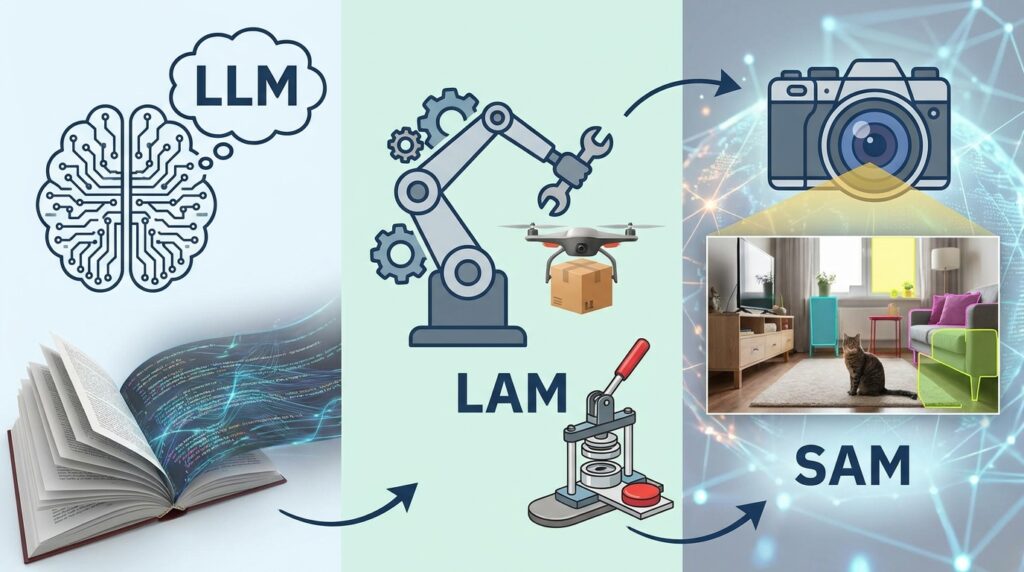
A Large Language Model (LLM) understands context and generates text, code, answers, and ideas. Tools like ChatGPT, Claude, and Gemini are built on LLMs — they’re excellent at producing language-based output, but on their own, they don’t take action in the outside world.
A Large Action Model (LAM) goes a step further: instead of just describing what to do, it interacts with tools, applications, and APIs to actually perform actions based on your instructions — clicking through a form, booking something, or executing a command in software.
A System or Agentic Model (SAM) represents a broader approach where AI plans tasks, coordinates multiple models and tools, executes multi-step workflows, and verifies the results along the way, rather than performing one isolated action.
The simplest way to remember the difference:
- LLM → Generate
- LAM → Generate + Act
- SAM → Plan + Generate + Act + Verify
One important caveat worth stating plainly: these terms aren’t used consistently across the AI industry. “LLM” is a well-established, standardized term. “LAM” has gained some traction — independent analysis of large action model terminology notes it was largely popularized by the device maker Rabbit and never achieved universal adoption across the broader AI community. “SAM” in this sense is even less standardized and is better understood as a practical shorthand for describing a capability level, not a formally recognized model category. Treat LLM vs LAM vs SAM as a useful mental framework, not an official industry taxonomy.
Step-by-Step Guide: Applying This Framework to Your Own AI Tool Choices
Step 1: Identify What You Actually Need the AI to Do

What to do: Before evaluating any specific tool, write down whether your task needs language output only, a specific action performed, or a full multi-step process managed end to end.
How to do it: Describe your task in one sentence and notice its shape. “Write a product description” is pure generation. “Update this spreadsheet row” involves taking an action. “Research competitors, draft a report, and schedule it for review” involves planning across multiple steps.
Why it matters: Each level of the LLM vs LAM vs SAM framework solves a genuinely different kind of problem. Picking a tool based on this distinction, rather than marketing language, saves you from either underpowered tools or unnecessarily complex ones.
Example: A freelance writer drafting blog posts needs LLM-level capability only. A virtual assistant updating a CRM record after every client call needs LAM-level action-taking.
Step 2: Use LLM-Level Tools for Pure Generation Tasks
What to do: For tasks that only require language output — drafting, summarizing, brainstorming, explaining — use a standard LLM-based chat tool directly.

How to do it: Open a tool like Claude, ChatGPT, or Gemini, describe your task clearly, and review the generated text yourself before using it.
Why it matters: This is the simplest, most reliable, and usually cheapest layer. There’s no reason to involve action-taking or multi-step planning capability for a task that’s purely about generating language.
Example: A freelance marketer drafting five variations of an ad headline needs nothing beyond a capable LLM — no tool integration or workflow planning required.
Step 3: Move to LAM-Level Tools When You Need Actions Taken
What to do: When your task requires the AI to actually do something in another application — not just describe what to do — look for tools with action-taking or API integration capability.

How to do it: Check whether the tool can connect to the specific application you need (a calendar, a CRM, an email platform) through built-in integrations, browser automation, or API access, rather than just producing text you’d have to manually copy elsewhere.
Why it matters: This is where the real time savings in the LLM vs LAM vs SAM framework show up for busy freelancers — skipping the manual step of copying AI-generated output into another application.
Example: An e-commerce freelancer using a tool that can directly update inventory counts in a connected store platform, rather than generating a list of numbers to be entered manually, is working at LAM-level capability.
Step 4: Reach for SAM-Level Systems Only for Genuinely Multi-Step Work
What to do: For tasks involving several dependent stages — research, drafting, scheduling, checking results, adjusting — look for agentic systems that can plan and coordinate across that full sequence.

How to do it: Evaluate whether the tool can break a goal into sub-tasks, use multiple tools or models in sequence, and verify its own output before considering the job done, rather than requiring you to manually trigger each step.
Why it matters: This is the most powerful level but also the most complex to set up and supervise. Reserve it for tasks that genuinely need multi-step coordination — using it for a simple task adds unnecessary complexity and unpredictability.
Example: A solo marketer using an agentic system to research a topic, draft content, schedule it, and later check performance metrics is working with SAM-level capability — a single prompt-and-response LLM interaction couldn’t handle that full sequence.
Step 5: Match Your Oversight Level to the Tool’s Capability
What to do: Apply more review and fewer unsupervised actions as you move from LLM to LAM to SAM-level tools.
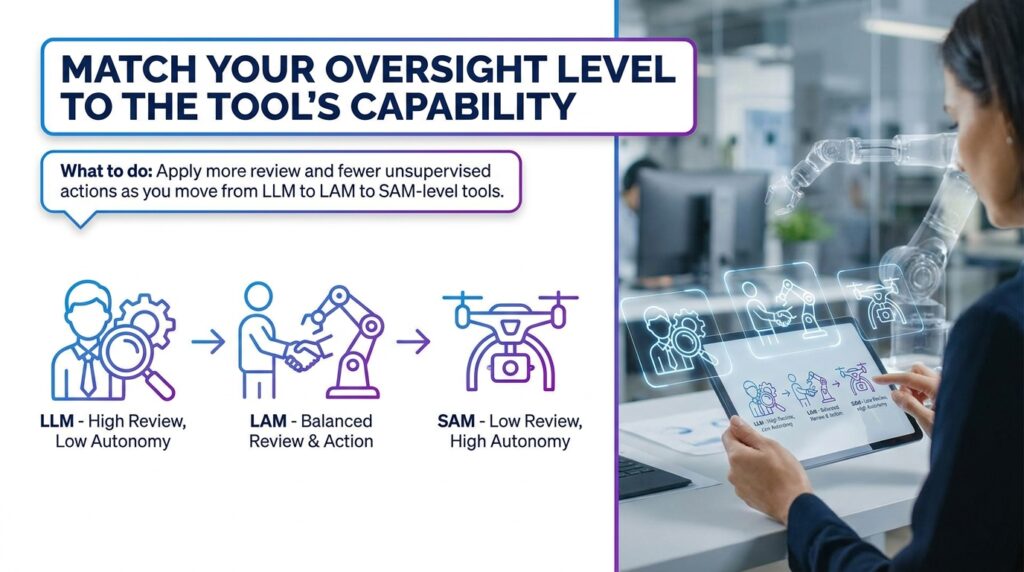
How to do it: For pure generation (LLM), reviewing the final text is usually enough. For action-taking tools (LAM), confirm actions before they’re executed when the stakes are meaningful — a payment, a public post, a client-facing message. For full agentic systems (SAM), build in checkpoints where you review progress partway through, not just the final result.
Why it matters: The further along this capability spectrum a tool operates, the more it can do without your direct input — which also means more that can go wrong before you notice.
Step 6: Test With Low-Stakes Tasks Before Relying on Higher-Level Tools

What to do: Before trusting a LAM or SAM-level tool with something important, run it on a reversible, low-stakes version of the same task first.
How to do it: Choose a test case where a mistake costs little — a draft email rather than a sent one, a test order rather than a real one — and observe how the tool actually behaves before scaling up.
Why it matters: Action-taking and agentic tools can fail in ways a pure text generator can’t — an incorrect action executed in the real world is harder to undo than a bad paragraph you simply don’t use.
Step 7: Reassess Periodically as Tools Evolve
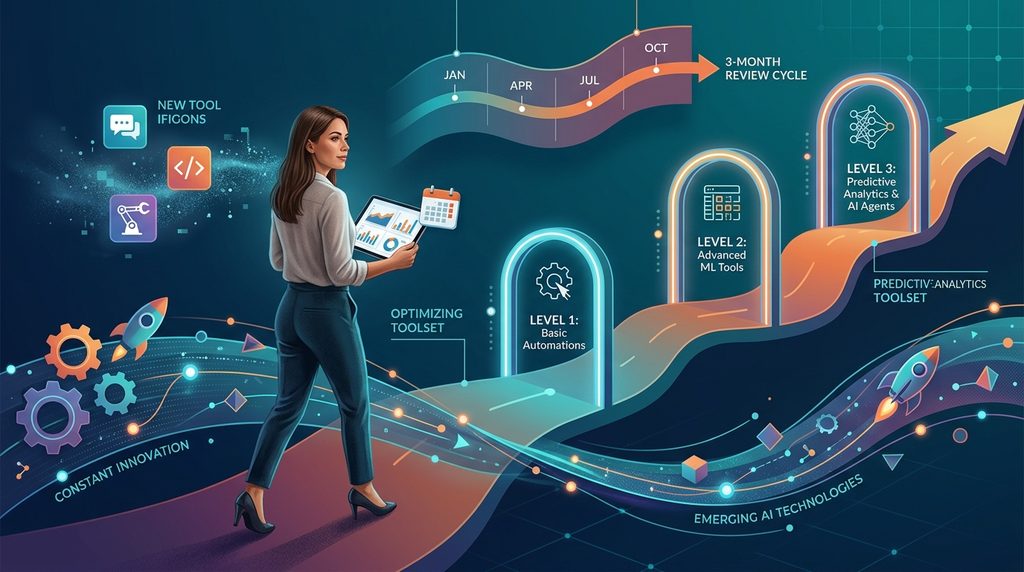
What to do: Revisit which level of tool you’re using every few months, since the AI tools market — and the boundaries between these categories — is moving quickly.
How to do it: Periodically check whether a task you’re currently handling with an LLM-only workflow now has a reliable LAM or SAM-level option worth testing, or whether a complex agentic tool has become simpler to manage than it was when you first evaluated it. If you’re building out a broader toolkit, it’s worth pairing this with our AI automation guides for freelancers for ideas on where these tools fit into your existing workflow.
Why it matters: The practical capabilities behind the LLM vs LAM vs SAM framework are advancing quickly, and a tool that required heavy manual oversight a year ago may now handle more independently.
Common Mistakes to Avoid
- Treating these as official, standardized industry categories. As the “What Is” section covers, “LAM” and especially “SAM” are practical shorthand, not formally agreed-upon classifications — don’t take vendor marketing claims at face value just because they use these terms.
- Using SAM-level tools for simple generation tasks. This adds unnecessary complexity, cost, and unpredictability to work an LLM could handle directly.
- Granting full unsupervised action-taking before testing on low-stakes tasks. As Step 6 covers, action-taking tools fail differently than pure text generators, and the cost of an error is often higher.
- Assuming more autonomy always means better results. A reliable, simple LLM workflow often outperforms an overcomplicated agentic setup for a straightforward task.
- Never revisiting your tool choices. As Step 7 covers, this field moves quickly, and a workflow that made sense months ago may now be outdated.
Useful Tips for Beginners
- Start every new task by asking “does this need generation, action, or full planning?” — the answer points directly to the right level in the LLM vs LAM vs SAM framework.
- Read a tool’s actual integration and permissions documentation, not just its marketing page, before trusting it with action-taking capability.
- Keep a running note of tasks where you’ve tested LAM or SAM-level tools, including what went wrong, so you’re not repeating the same evaluation from scratch each time.
- When in doubt, default to the simplest level that solves your actual problem — complexity should be earned by the task, not assumed from the start.
- Follow updates from credible AI research sources rather than relying solely on product marketing, since terminology and capability in this space shift quickly.
Frequently Asked Questions
1. Is a LAM always better than a standard LLM? No. A LAM adds action-taking capability, which is valuable for tasks requiring it, but it’s unnecessary complexity for tasks that only need generated text. Match the tool to the task, not the other way around.
2. Are “LAM” and “SAM” official technical terms I’ll see in research papers? “LAM” appears in some product marketing and a growing body of technical discussion, though it isn’t universally standardized. “SAM” in this specific sense is closer to an informal explanatory shorthand than a term you’ll find consistently used across the AI research community — “agentic AI” or “multi-agent systems” are the more commonly used terms for that broader category.
3. Can one tool operate at multiple levels of the LLM vs LAM vs SAM framework? Yes, increasingly so. Many modern AI platforms combine generation, action-taking, and some degree of multi-step coordination within a single product, blurring these lines in practice even though the underlying capabilities remain distinct.
4. Do I need technical or coding skills to use LAM or SAM-level tools? Not always. Many no-code platforms now offer action-taking and basic agentic capability through visual builders, though more advanced or custom setups may require technical skills or a developer’s help.
5. Will understanding this framework help me choose better AI tools for freelance work? It can help you ask more precise questions when evaluating a tool — specifically, what it actually does versus what it claims — rather than guaranteeing a particular outcome for your business.
Final Thoughts
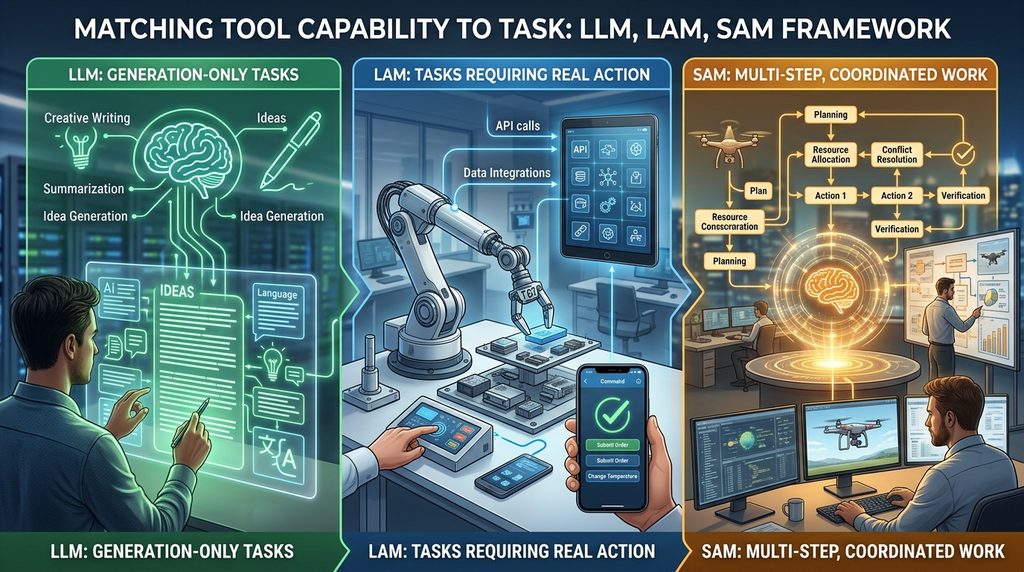
The real value of the LLM vs LAM vs SAM framework isn’t memorizing three acronyms — it’s having a practical way to match a tool’s actual capability to what your task genuinely requires. Generation-only tasks need an LLM. Tasks requiring real action need LAM-level integration. Multi-step, coordinated work needs SAM-level planning and verification.
Next time you’re evaluating a new AI tool, start by identifying which of these three levels your actual task needs, and test it on something low-stakes before trusting it with anything important. That practical habit will serve you better than any single tool recommendation.