Google Carbon vs Neon: A Proven Tech Specialist Review of Capabilities, Speed, and Real-World Value
The Google Carbon vs Neon debate just reshaped how developers, freelancers, remote workers, and digital entrepreneurs choose their daily AI engine. On November 18, 2026, Google rolled out Gemini 4 Neon—positioned right between the rapid Gemini 4 Hydrogen and the heavy-duty Gemini 4 Carbon—promising near-flagship intelligence at roughly twice the output speed and a lower cost per completed task.
If you run a solo digital business, manage client websites, write code, or build scalable content systems, choosing the wrong model quietly drains both your budget and your hours. Paying for deep, slow reasoning on everyday tasks burns API credits unnecessarily, while relying on a lightweight model for complex architecture or technical audits leads to costly errors.
In this evidence-backed tech specialist review, we break down the exact capabilities of Google Carbon vs Neon using official Google benchmarks, independent Artificial Analysis testing, and verified November 2026 pricing. Better yet, we show you how to apply these models to the 6-Layer SEO → AEO → AI Visibility framework so you can turn AI speed into measurable digital growth—without falling for hype or unrealistic income promises.
What Is Google Carbon vs Neon?
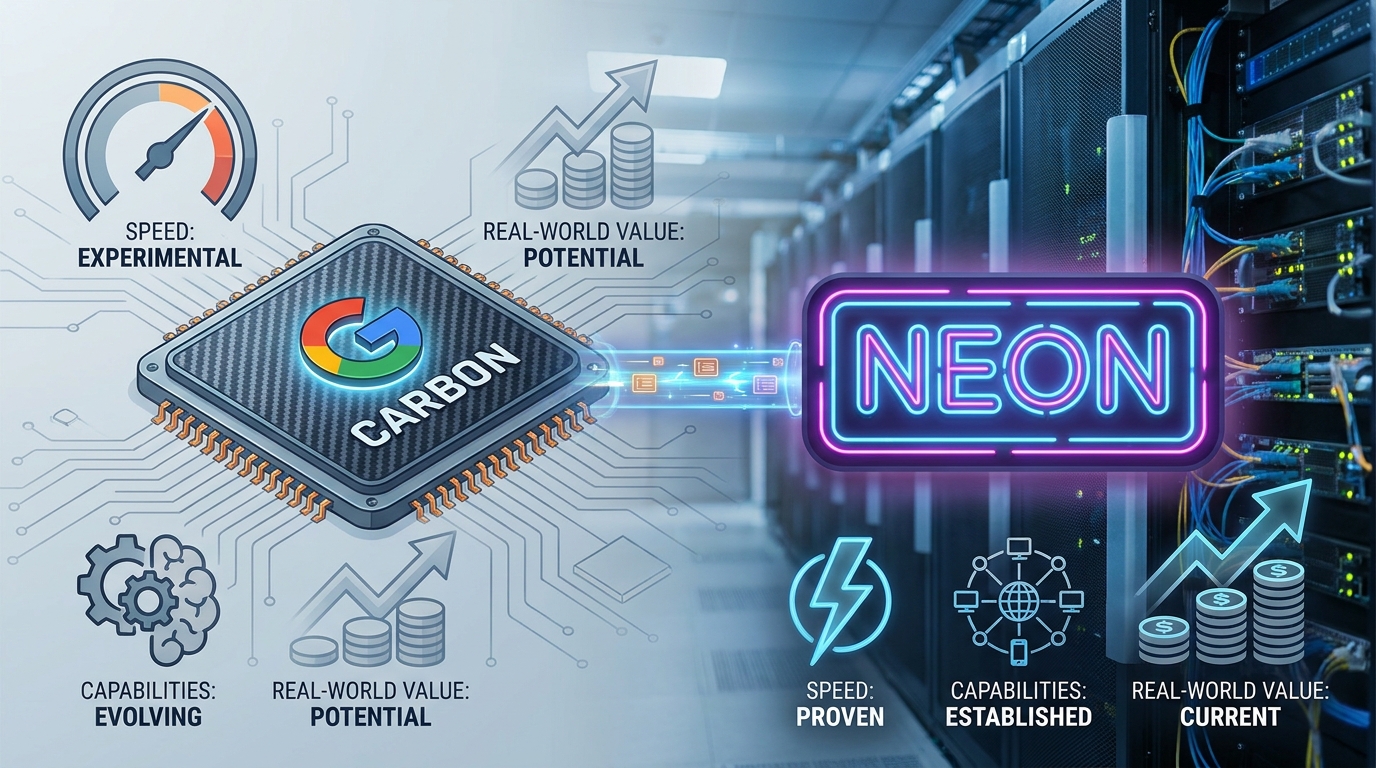
At its core, the Google Carbon vs Neon comparison is a matchup between two specialized frontier models in Google’s Gemini 4 family. Rather than forcing every user onto a single “one-size-fits-all” model, Google designed these two releases to sit at different points on the tradeoff curve between raw reasoning depth, execution speed, and API cost.
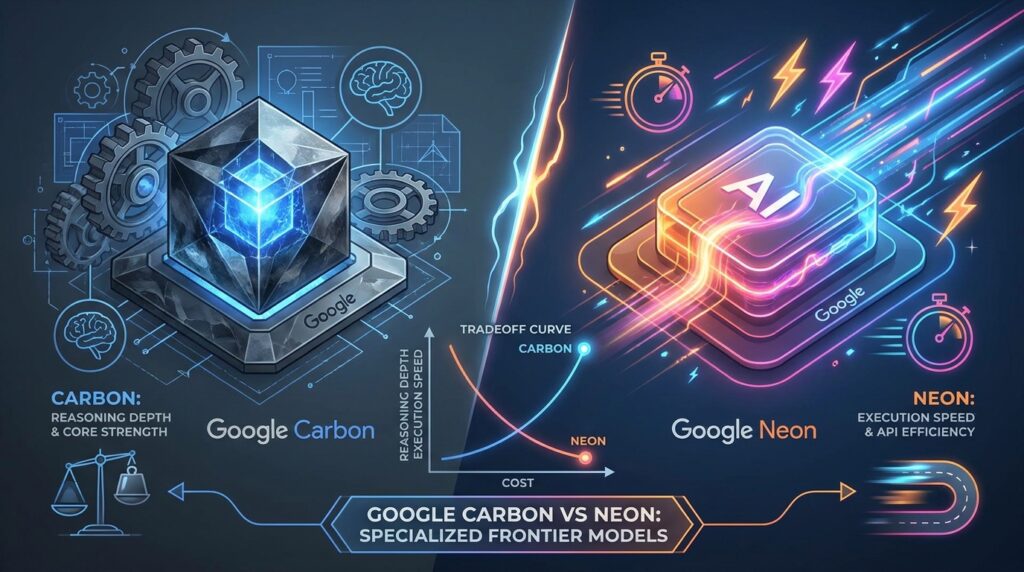
- Gemini 4 Carbon (
gemini-4-carbon): Announced on October 28, 2026, and opened widely on November 10, 2026, Carbon is Google’s deep-thinking specialist. It is built for sustained, long-horizon agentic workflows—such as ambiguous system architecture, repository-wide migrations, research-level physics, and complex problems where a faster model might get stuck. - Gemini 4 Neon (
gemini-4-neon): Launched on November 18, 2026, Neon is adapted from Carbon and engineered for fast end-to-end task completion. It handles complex coding, multi-step enterprise analysis, spreadsheet modeling, and cybersecurity defense at roughly double Carbon’s output speed.
Both models share a massive 1,048,576-token (1M) context window and accept multimodal inputs—including text, images, PDFs, audio, and video—while producing text outputs. Neither model is available on the free Gemini tier.
Core Capabilities: Benchmarks, Speed, and Cost Compared
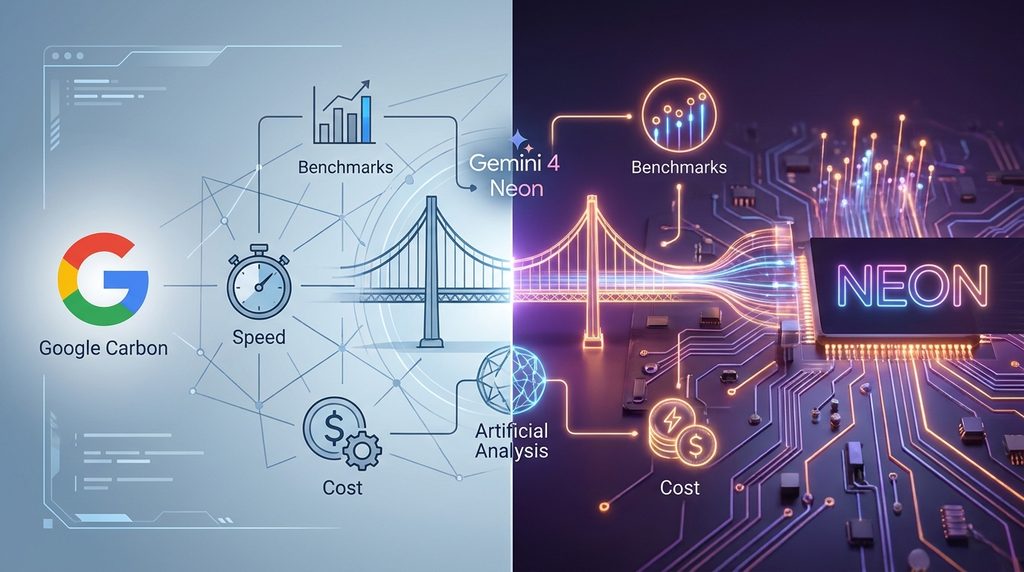
To evaluate Google Carbon vs Neon objectively, we need to look past marketing headlines and examine independent numbers from Artificial Analysis alongside Google’s official Gemini 4 Neon announcement.
| Capability Metric | Gemini 4 Carbon | Gemini 4 Neon | Specialist Verdict |
| Intelligence Index (Artificial Analysis) | 60.0 (High) | 61.0–61.4 (xhigh) / 59.6 (High) | Tie on raw intelligence at High; Neon edges ahead at xhigh. |
| Output Speed | ~55 tokens/sec | ~100–110 tokens/sec | Neon wins (~2x faster output generation). |
| Average Time per Index Task | ~36.6–37 min (High) | ~14.8–21.5 min | Neon wins (roughly 40%–60% faster completion). |
| Coding Agent Index (AA) | 55.5 (High) | 58.6 (xhigh — #1 overall) | Neon wins for multi-file debugging and agentic coding. |
| Research-Level Physics (CritPt) | 69.0 | 59.0 (max 62) | Carbon wins clearly on hardest scientific reasoning. |
| Non-Hallucination Rate (AA Omniscience) | 88.6% (High) / 95.8% (Med) | 86.1% | Carbon wins slightly on strict factual restraint. |
| Cybersecurity Patching (CWE-bench v2) | 67.3% (baseline) | 70.7% (+3.4% uplift) | Neon wins using half the tokens on ExploitGym. |
| API Pricing (Through Nov 30, 2026) | $2 input / $10 output per 1M | $3 input / $15 output per 1M | Carbon is cheaper per token during intro pricing. |
| API Pricing (From Dec 1, 2026) | $4 input / $20 output per 1M | $3 input / $15 output per 1M | Neon wins (25% cheaper per token; up to 43%–52% less per task). |
The Positive and Negative Reality
- The Positive: In the Google Carbon vs Neon matchup, Neon breaks the usual AI rule that faster and cheaper means dumber. It matches Carbon’s overall intelligence while cutting wait times nearly in half, and Google reports a 32% lower cost per task at default high thinking—with independent tests showing a 43%–52% per-task savings once Carbon’s introductory pricing ends on December 1, 2026.
- The Negative: Both models are verbose, meaning your API bill will skew heavily toward output tokens (which include thinking tokens). Furthermore, Neon does not generate images or audio, does not support the Live API, and supports implicit caching only (requiring a 4,096-token minimum stable prefix) rather than explicit caching.
Global Availability and Regional Restrictions (Updated November 2026)
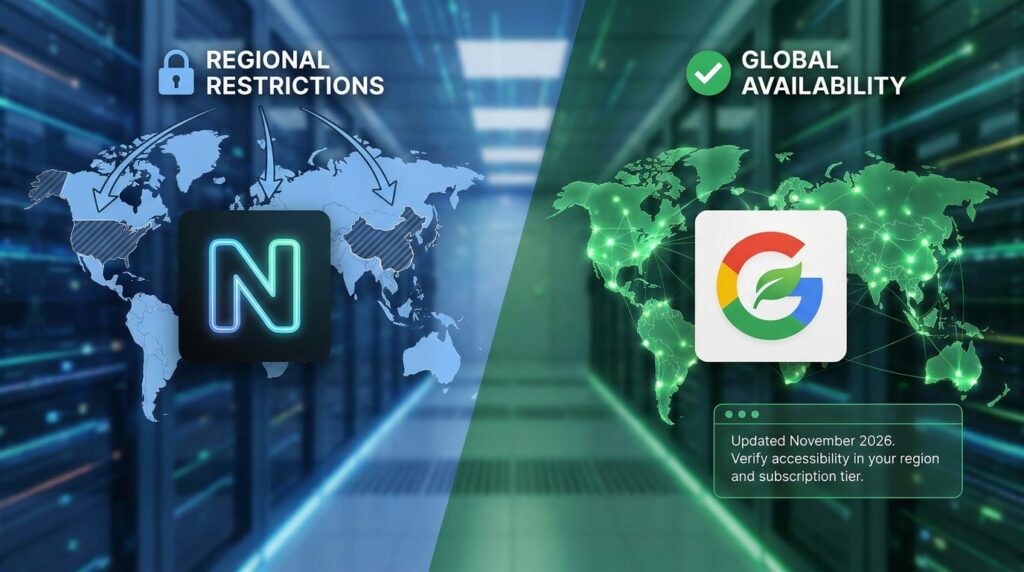
Before building your workflow around Google Carbon vs Neon, verify what is actually accessible in your region and subscription tier:
- Subscription Plans: Gemini 4 Neon is available to Google AI Pro and Google AI Ultra subscribers in the Gemini app, Google AI Studio, and Google Antigravity. Gemini 4 Carbon is included for Google AI Ultra subscribers and paid API/enterprise users. Neither model is included in the free Gemini plan or Google AI Plus.
- Country Availability: Google AI Pro and Google AI Ultra are available in more than 150 countries and territories. While Google’s official launch post does not list blanket country bans for Neon, specific bundled integrations carry strict regional limits—for example, Gmail AI Overview is currently US-only, Chrome auto browse is limited to the US and India, and Gemini Tasks free access is restricted to six countries.
- Cybersecurity Access: Both Gemini 4 Carbon and Gemini 4 Neon for cyber are restricted to vetted security defenders through Google’s Fairwind Program.
How to Use Google Carbon vs Neon Across the 6-Layer AI Visibility System
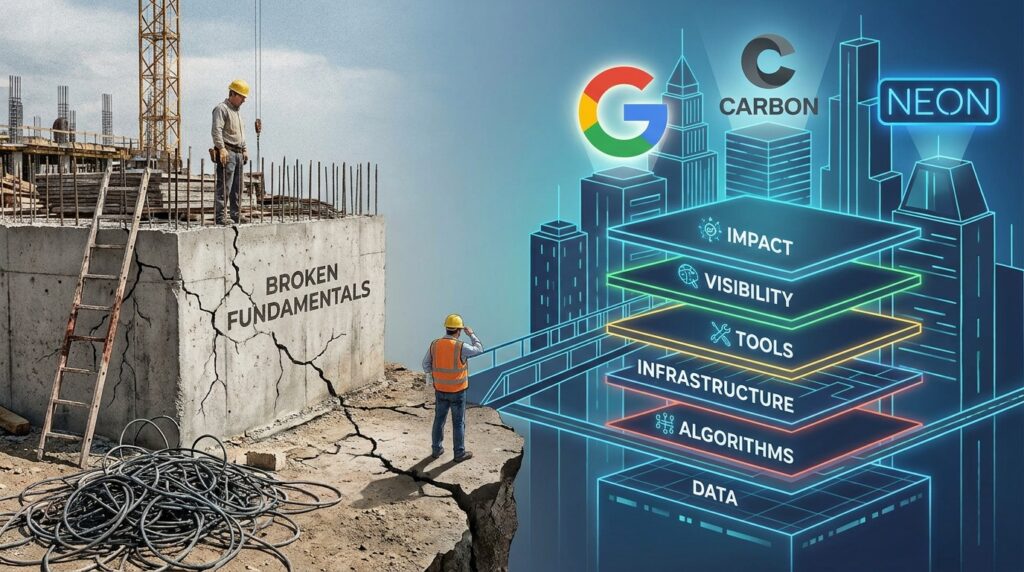
Understanding Google Carbon vs Neon is only half the battle. Whether you are a freelance SEO specialist, a remote developer, or an entrepreneur building a content business, the biggest mistake you can make is chasing advanced AI tactics while your website still has broken fundamentals.
Search visibility today is not a collection of shortcuts. It is a layered system:Crawlability → Brand Consistency → Answers → Citations → Recommendations → Conversion.
If you skip Layer 1, everything below it becomes harder. Here is how to execute each layer using the right Gemini 4 model—and if you are still building your broader tech stack, check out our guide to essential AI tools for remote workers to see how these models fit alongside your everyday productivity apps.
Layer 1: Crawlability (Fix the Foundation First)
- What to do: Ensure search engine bots and AI crawlers can read, render, and index your pages without hitting
robots.txtblocks, broken redirects, or heavy JavaScript bottlenecks. - How to do it: Export your server logs,
robots.txt, and XML sitemap, then upload them into Gemini 4 Neon (using its 1M-token context window). Ask Neon to flag crawl traps, orphan pages, and accidentalnoindexdirectives. - Why it matters: Crawlability is the most overlooked layer—and one of the cheapest to fix. If crawlers cannot access your page, your content effectively does not exist.
- Practical Example: A freelance web developer auditing a 500-page e-commerce site uses Neon in Google Antigravity to inspect
robots.txtand site templates in minutes, catching a stagingdisallowrule that was blocking product pages from indexing.
Layer 2: Brand Consistency (Align Your Digital Identity)
- What to do: Align your positioning, bio, service offerings, and terminology across your website, LinkedIn, Reddit, GitHub, and X.com.
- How to do it: Feed your website’s About page, LinkedIn profile, and social bios into Gemini 4 Neon. Prompt it to identify conflicting value propositions, outdated titles, or inconsistent brand messaging.
- Why it matters: Different positioning across platforms makes your brand look like multiple unrelated businesses to both human clients and AI knowledge graphs.
- Practical Example: A remote UX consultant whose website says “SaaS Product Designer” while their LinkedIn says “Freelance Graphic Artist” uses Neon to unify both profiles under one clear specialty, improving both client trust and entity recognition.
Layer 3: Answer the Question (Where SEO and AEO Overlap)
- What to do: Build content around the exact questions your target audience searches for. Turn each H2 heading into a real buyer or user question and answer it directly underneath in clear, scannable prose.
- How to do it: Use Gemini 4 Neon to cluster customer support tickets, forum questions, and keyword data into structured H2 outlines. For highly technical, research-heavy topics where accuracy is non-negotiable, verify your claims with Gemini 4 Carbon, which holds a higher non-hallucination rate (up to 95.8% at Medium).
- Why it matters: Answer Engine Optimization (AEO) and traditional SEO meet right here. Clear, direct answers under question-based headings make it easy for both Google Search and AI assistants to extract your expertise.
- Practical Example: Instead of writing a vague heading like “Model Pricing,” a tech reviewer writes “Which Is Cheaper: Google Carbon vs Neon After December 1?” and immediately gives the exact $3/$15 vs. $4/$20 breakdown.
Layer 4: Get Cited (Build Visibility Where AI Looks)
- What to do: Expand your footprint beyond your own domain into communities, industry publications, and technical forums where AI systems actively discover consensus.
- How to do it: Use Gemini 4 Neon to repurpose your core research into genuinely helpful, non-promotional answers for Reddit, LinkedIn, and niche Slack or Discord communities.
- Why it matters: Your website is not the only place AI systems pull information. Being discussed accurately in trusted third-party spaces reinforces your authority.
- Practical Example: An independent cybersecurity freelancer publishes a benchmark breakdown of Google Carbon vs Neon on their blog, then shares a concise summary of the CWE-bench v2 patching results in a developer forum—earning organic backlinks and brand mentions.
Layer 5: Become the Answer (Earn Recommendations Over Time)
- What to do: Publish original case studies, real benchmarks, specific workflow results, and credible numbers that give AI systems concrete evidence to cite.
- How to do it: When analyzing large datasets, multi-quarter client metrics, or complex financial spreadsheets, run your deep analysis in Gemini 4 Carbon (for sustained, multi-step verification) or Gemini 4 Neon (for fast spreadsheet modeling).
- Why it matters: Being mentioned is different from being recommended. Generic summaries get ignored; original data and transparent methodology get recommended.
- Practical Example: A digital agency documents how switching a client’s internal documentation pipeline from Carbon to Neon cut API task costs by an estimated 40% while maintaining output quality—turning a routine project into a citable case study.
Layer 6: Convert the Visitor (Respect Their Time)
- What to do: Design your pages so visitors who already know what they want can find the answer, comparison table, or call-to-action immediately without digging through fluff.
- How to do it: Use Gemini 4 Neon to audit your top-performing landing pages for friction—long introductions, buried pricing, or unclear next steps—and rewrite them for clarity.
- Why it matters: Search traffic and AI citations only create value if your website converts visitors into subscribers, leads, or customers.
- Practical Example: A job seeker’s portfolio site places a scannable “Skills & Case Studies” table above the fold instead of a 600-word biography, making it effortless for recruiters to book an interview.
Common Mistakes to Avoid
Even experienced digital professionals stumble when adopting Google Carbon vs Neon. Watch out for these four pitfalls:
- Optimizing for AI Answers Before Fixing Technical SEO: Chasing AI citations while your site has broken links, slow mobile load times, or blocked crawlers wastes months of effort. Always start at Layer 1.
- Using Carbon for High-Frequency Everyday Work: Carbon’s deep reasoning is impressive, but waiting 37 minutes per complex agent task—and paying $4/$20 per million tokens starting December 1, 2026—will quickly erode freelance or agency margins.
- Ignoring Output Token Verbosity: Both models generate substantial thinking and output tokens. Failing to set appropriate thinking levels (
medium,high, orxhigh) or ignoring implicit caching (4,096+ token stable prefixes) can inflate your monthly API bill. - Treating AI Benchmarks as Guaranteed Real-World Results: Benchmark scores like Artificial Analysis’s 61 vs. 60 are useful baselines, not guarantees. Always test Google Carbon vs Neon on your own prompts before migrating a production workflow.
Useful Tips for Beginners and Digital Professionals
- Make Neon Your Default for Serious Daily Work: If you do multi-file debugging, complex client research, spreadsheet modeling, or structured content production, start with Gemini 4 Neon.
- Reserve Carbon for High-Stakes Edge Cases: Switch to Gemini 4 Carbon when the cost of a subtle error outweighs the API bill—such as ambiguous system architecture, deep repository-wide refactors, or scientific research.
- Pair Neon with Hydrogen for Budget Efficiency: In Google Antigravity and agentic workflows, use Neon as the orchestrator to plan the task and delegate fast, high-volume subtasks to Gemini 4 Hydrogen.
- Re-Audit Your API Costs After December 1, 2026: Carbon’s introductory pricing ($2/$10) expires on November 30, 2026. Set a calendar reminder to review your token spend and shift eligible workloads to Neon ($3/$15).
Frequently Asked Questions
1. Which is better in Google Carbon vs Neon for everyday freelance and remote work?
For most freelancers, remote workers, and digital professionals, Gemini 4 Neon is the better daily driver. It matches Carbon’s raw intelligence on major benchmarks while running roughly twice as fast and costing significantly less per completed task after Carbon’s introductory pricing ends.
2. Is Gemini 4 Neon available on the free Google Gemini plan?
No. According to Google’s official documentation, Gemini 4 Neon is not available on the free tier or Google AI Plus. You need a Google AI Pro or Google AI Ultra subscription, or a paid Gemini API / Gemini for Business account.
3. When should I still choose Gemini 4 Carbon over Neon?
Choose Gemini 4 Carbon when tackling exceptionally difficult, long-horizon engineering problems, research-level physics, or tasks where a lower hallucination rate and extended persistence through dead ends matter more than speed or token cost.
4. Can Google Carbon or Neon generate images or audio?
No. Both models accept multimodal inputs (text, images, PDFs, audio, and video) within a 1 million-token context window, but they output text only.
Final Thoughts
The Google Carbon vs Neon comparison proves that raw model size is no longer the only metric that matters. Gemini 4 Neon has effectively become Google’s new default for demanding, high-frequency professional work—delivering frontier-level coding, analysis, and cybersecurity capabilities at twice the speed and a lower post-December 1 cost. Meanwhile, Gemini 4 Carbon remains the dedicated specialist for your hardest, longest-horizon challenges where deep verification is worth the wait.
To turn these capabilities into real career or business momentum, take these next practical steps:
- Audit Layer 1 (Crawlability) on your website or portfolio before chasing advanced AI visibility tactics.
- Test both models on one real task from your weekly workflow—not just generic prompts.
- Lock in your budget before Carbon’s API rates double on December 1, 2026.
Which layer of the AI visibility system are you focusing on right now?